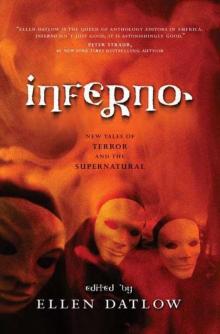
Edited by, p.1
Edited By, page 1


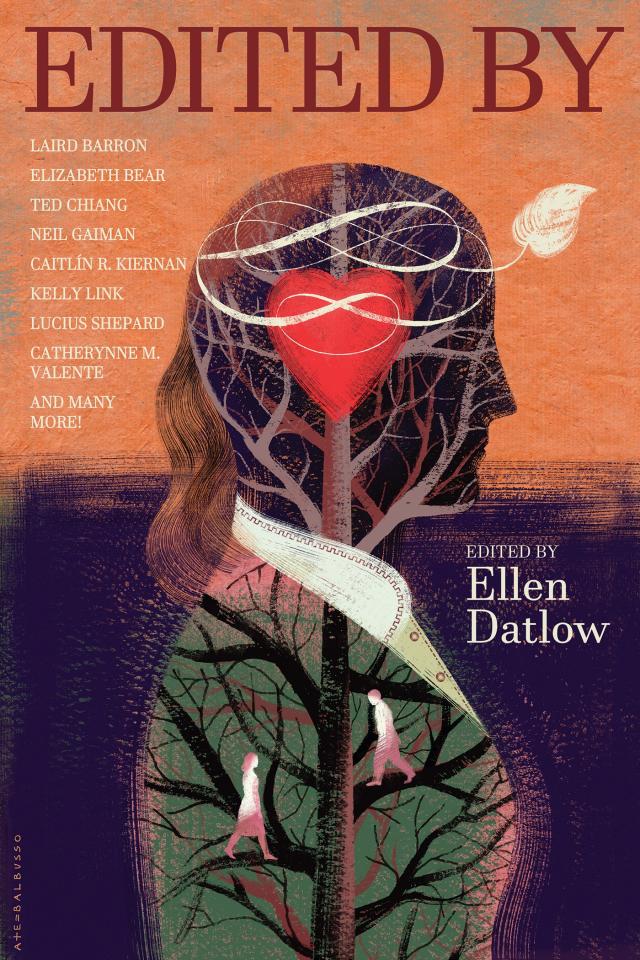
Edited By Copyright © 2020
by Ellen Datlow.
All rights reserved.
Dust jacket illustration Copyright © 2020
by Anna & Elana Balbusso c/o the i spot.
All rights reserved.
Interior design Copyright © 2020
by Desert Isle Design, LLC.
All rights reserved.
Electronic Edition
ISBN
978-1-59606-967-1
See pages here for individual story credits.
Subterranean Press
PO Box 190106
Burton, MI 48519
subterraneanpress.com
Manufactured in the United States of America.
This book is dedicated to all the writers
I’ve been working with over the years.
You, my dears, have given me a joyous career.
Acknowledgments
Thanks to Betsy Mitchell and Open Road Media for getting me manuscript files for some of my anthologies that were published in the stone ages, before the existence of electronic files.
Thanks to William Schafer of Subterranean, who came up with the idea—I thought/think he’s crazy, but hey, what doI know?
Thanks to all my authors who provided me with electronic copies of their stories, whether I used those stories or not.
Finally, a special thanks to those who run the Internet Speculative Fiction Database (isfdb) for its invaluable help not only in writing story notes for this book, but for being such a useful reference tool.
Table of Contents
Introduction by Gary K. Wolfe
Home by the Sea by Pat Cadigan
The Evolution of Trickster Stories Among the Dogs of North Park After the Change by Kij Johnson
The Bedroom Light by Jeffrey Ford
The Carrion Gods in Their Heaven by Laird Barron
The Crow Palace by Priya Sharma
Some Strange Desire by Ian McDonald
The Lepidopterist by Lucius Shepard
Bird Count by Jane Yolen
Anamorphosis by Caitlín R. Kiernan
The Hortlak by Kelly Link
In the Month of Athyr by Elizabeth Hand
Precious by Nalo Hopkinson
Daniel’s Theory About Dolls by Stephen Graham Jones
The Mysteries by Livia Llewellyn
Dancing Men by Glen Hirshberg
The Office of Doom by Richard Bowes
Black Nightgown by K. W. Jeter
A Delicate Architecture Catherynne M. Valente
The Goosleby Margo Lanagan
Eaten(Scenes from a Moving Picture) by Neil Gaiman
Teratisms by Kathe Koja
The Monsters of Heaven by Nathan Ballingrud
That Old School Tie by Jack Womack
Love and Sex Among the Invertebrates by Pat Murphy
Overlooking by Carol Emshwiller
Sonny Liston Takes the Fallby Elizabeth Bear
Technicolor by John Langan
The Sawing Boys by Howard Waldrop
Shay Corsham Worsted by Garth Nix
Seventy-Two Letters by Ted Chiang
Interview with Ellen Datlow by Gwenda Bond
Introduction:
The Fiction Editor
Gary K. Wolfe
Fantasy, science fiction, and horror writers love their editors.
Well, maybe not all editors, and maybe not all the time, and there might be a certain number of writers who view rejection notes or requests for revisions as though they were challenges to the dueling field. But by and large writers recognize that their genres were shaped, and in some cases nearly invented, by the short fiction editors—first in the pulp magazines, later in their digest-sized inheritors and anthologies, and in a few cases in the handful of mainstream magazines which were receptive to genre fiction. (Book and novel editors specializing in genre didn’t really become a force in the field until the 1950s for science fiction, and even later for genre fantasy and horror.) When the first big science fiction and horror anthologies appeared in the 1940s, they were a way of preserving in book form stories which had originally appeared in ephemeral magazines, but by the early 1950s editors like Frederik Pohl and Raymond Healy were introducing anthologies of all original stories. Today, building an anthology of original stories—or a mix of originals and reprints, as Ellen Datlow has sometimes done—can be seen as an art form in itself, an almost musical one. A good anthology has a shape and a rhythm (even though, as Datlow notes, not every reader follows the order of stories as presented), with a mix of counterpoint, harmony, and occasional dissonance, and almost always with a few surprises.
A generation of readers in the 1950s learned to appreciate short fiction not only from the magazines, but from anthologists like Groff Conklin, August Derleth, or Judith Merril; in the 1960s it might have been Terry Carr or Robert Silverberg or Harlan Ellison, in the 1970s Damon Knight or Harry Harrison, in the 1980s (for horror in particular) Charles M. Grant. By the 1980s, Gardner Dozois had come to dominate the “year’s best science fiction field,” while an equally influential companion volume,The Year’s Best Fantasy and Horror, was co-edited by Terri Windling and Ellen Datlow. Nowadays, of course, editors may buy fiction for online magazines or websites as well as print magazines, but the anthology remains a crucial part of the field, and to a great extentEdited By is a celebration of—well, of anthologies in general, and in particular of the work of one of the most prolific and widely honored anthologists the field has ever seen.
Those honors which Datlow has received are another indication of the degree to which the fantastic genres recognize and celebrate their editors. (To my knowledge, this is not generally true of genres like mysteries or romance.) With the exception of the Nebula Award (which is specifically designated for writers), nearly every major award in the field includes categories for editors and/or anthologies—and in fact the most prominent science fiction award, the Hugo, is even named after the field’s first prominent editor, Hugo Gernsback, even though by modern (or even not-modern) literary standards, he wasn’t really very good as an editor. Datlow has won, so far, eight Hugo Awards out of twenty nominations since 1990. She’s also won ten World Fantasy Awards out of an astonishing 46 nominations, five Bram Stoker Awards for horror out of 18 nominations, 14 Locus Awards out of a ridiculous 98 nominations, three Shirley Jackson Awards out of 11 nominations, and two British Fantasy Awards out of nine nominations. This is in addition to lifetime achievement honors from World Fantasy and the Bram Stoker Awards and a special Karl Edward Wagner Award from the British Fantasy Society. The awards won by authors and stories she has published, dating all the way back to her fiction editing ofOmnimagazine in 1981, would be daunting to even begin to calculate—but, as Datlow herself would be the first to point out, awards aren’t really the issue.
What is an issue, perhaps, is the sheer variety ofkindsof anthologies represented in this volume. Note that the litany above includes awards for fantasy, for science fiction, and for horror—genres which have sometimes been given collective labels like supergenre, metagenre, or (in critic John Clute’s term) fantastika, but which can also eye each other warily across the room, as though someone might be hogging the sweets table. Each genre has its devoted readers who want little to do with their alleged sister genres, and each has its dedicated awards and conventions. But since the beginning of her career, Datlow has helped to shape the tastes of readers in each of these fields, and probably to help broaden those tastes as well. She first came to prominence as the fiction editor of the slick science-and-fiction magazineOmni (and its online successor) from 1981 to 1998, during which time the magazine published not only classic SF stories by virtually every major writer in the field, but work by widely-known “mainstream” authors such as Joyce Carol Oates and T. C. Boyle, and stories which sometimes blurred the boundaries of the fantastic genres. AfterOmnifolded, Datlow went on to edit fiction for the online venuesEvent Horizon andSci Fiction, and since 2013 has acquired fiction forTor.com.
While still atOmni, Datlow began a two-decade stint co-editingThe Year’s Best Fantasy and Horror, with Terri Windling choosing the fantasy selections and Datlow separately responsible for horror—although occasionally a particular story would be chosen by both in tandem, again reinforcing the notion that the line between fantasy and horror could often be arbitrary. About the same time, and while she was also editing a well-received series of anthologies drawn fromOmni(but including original fiction as well), Datlow assembledBlood is Not Enough: 17 Stories of Vampirism, a collection of mostly original poems and stories, which began a long series of themed anthologies includingAlien Sex(1990), A Whisper of Blood(1991), and many others, including another series of collaborations with Terri Windling. These various anthologies ranged from stories based on fairytales, folk legends, and trickster tales to tributes to authors like H.P. Lovecraft, Edgar Allan Poe, and Lewis Carroll and even collections focused on such particular themes as birds and dolls. As many of the stories which follow demonstrate, Datlow’s (or Datlow and Windling’s) ideas for such anthologies prompted some very distinguished writers to come up with some very distinguished work that might not have been written at all otherwise. See in particular the stories by Kij Johnson, Howard Waldrop, Catherynne Valente, Pat Cadigan, Carol Emshwiller, Ted Chiang, Nalo Hopkinson, Priya Sharma, John Langan, Jane Yolen, Jeffrey Ford, and Richard Bowes.
Datlow also has an impressive track record of spotting and inviting into her anthologies new or relatively new talent, such as Caitlín R. Kiernan (who had yet to publish her first novel when “Anamorphosis” appeared), Nalo Hopkinson (whose second story appeared in a Datlow/Windling anthology), and Ted Chiang. The Chiang story included here, “Seventy-Two Letters,” was only his fifth published story—but Datlow had also bought his first, “Tower of Babylon,” forOmni in 1990. Similarly, Nathan Ballingrud had published only a handful of stories prior to “The Monsters of Heaven,” and much the same is true of Glen Hirshberg, whose second published story had been sold to Datlow when she was editingSci Fiction. For two decades, many aspiring writers regarded an appearance inThe Year’s Best Fantasy and Horror—or even an “honorable mention”—as a sign of having arrived, or at least of having made it onto the genre’s radar.
On Datlow’s website,ellendatlow.com,she simply identifies herself as “Fiction Editor,” which sounds pretty unprepossessing until you realize what it means for a career now in its fourth decade. “Anthologist” would be far too limiting, since another equally impressive anthology could be compiled from stories she has acquired for magazines or online venues (and I, for one, would like to see it). Few editors, even the legendary ones, have had careers as durable and wide-ranging: Hugo Gernsback’s tenure as an editor of any real influence barely lasted a decade past the founding ofAmazing Stories in 1926, and while John W. Campbell, Jr. lasted 34 years as editor ofAstounding/Analog, arguably his influence had begun to wane by the 1960s. Groff Conklin, one of the few anthologists to work in horror as well as science fiction, edited volumes from 1946 until his death in 1968 (with a couple of posthumous titles later), while Judith Merril’s active career lasted 20 years, mostly of “year’s best” volumes. With the 40th anniversary of her career approaching, probably faster than she would like to think, Datlow shows no signs of flagging, remaining as open as ever to new voices and new directions in fantastic fiction, and as inventive in finding new themes to explore (birds! dolls! carnivals! Mad Hatters!). But as the stories that follow demonstrate, there’s far more to Datlow’s career than a record-breaking run and an almost unprecedented string of honors: there is, above all, the fiction, much of which we would never have seen except for the exceptional taste, the ingenious ideas—and occasionally the tireless nudging and cajoling—of the Fiction Editor.
Home by the Sea
by Pat Cadigan
(From A Whisper of Blood, 1991)
There was no horizon line out on the water.
“Limbo ocean. Man, did we hate this when I was a commercial fisherman,” said a man sitting at the table to my left. “Worse than fog. You never knew where you were.”
I sneaked a look at him and his companions. The genial voice came from a face you’d have expected to find on a wanted poster of a Middle Eastern terrorist, but the intonations were vaguely Germanic. The three American women with him were all of a type, possibly related. A very normal-looking group, with no unusual piercings or marks. I wondered how long they’d been in Scheveningen.
I slumped down in my chair, closed my eyes, and lifted my face to where I thought the sun should be. It was so overcast, there wasn’t even a hot spot in the sky. Nonetheless, the promenade was crowded, people wandering up and down aimlessly, perhaps pretending, as I was, that they were on vacation. It was equally crowded at night, when everyone came to watch the stars go out.
Of course we’re on vacation, a woman had said last night at another of the strange parties that kept congealing in ruined hotel lobbies and galleries. This had been one of the fancier places, ceilings in the stratosphere and lots of great, big ornate windows so we could look out anytime and see the stars die. It’s an enforced vacation. Actually, it’s the world that’s gone on vacation.
No, that’s not it, someone else had said in an impeccable British accent. It always surprised me to hear one, though I don’t know why; England wasn’t that far away. What it is, is that the universe has quit its job.
Best description yet, I’d decided. The universe has quit its job.
“Hey, Jess.” I heard Jim plop down in the chair next to me. “Look what I found.”
I opened my eyes. He was holding a fan of glossy postcards like a winning poker hand. Scheveningen and The Hague as they had been. I took them from him, looked carefully at each one. If you didn’t know any better, you’d have thought it had been a happy world, just from looking at these.
“Where’d you find them?”
“Up a ways,” he said, gesturing vaguely over his shoulder. He went up a ways a lot now, scavenging bits of this and that, bringing them to me as if they were small, priceless treasures. Perhaps they were—souvenirs of a lost civilization. Being of the why-bother school now, myself, I preferred to vegetate in a chair. “Kid with a whole pile of them. I traded him that can of beer I found.” He stroked his beard with splayed fingers. “Maybe he can trade it for something useful. And if he can’t, maybe he can fill a water pistol with it.”
What would be useful, now that the universe had quit its job? I thought of making a list on the back of one of the postcards. Clothing. Shelter. Something to keep you occupied while you waited for the last star to go out—a jigsaw puzzle, perhaps. But Jim never showed up with one of those, and I wasn’t ambitious enough to go looking myself.
My old hard-driving career persona would have viewed that with some irony. But now I could finally appreciate that being so driven could not have changed anything. Ultimately, you pounded your fist against the universe and then found you hadn’t made so much as a dent, let alone reshaped it. Oddly enough, that knowledge gave me peace.
Peace seemed to have settled all around me. Holland, or at least this part of Holland, was quiet. All radio and TV communications seemed to be permanently disrupted—the rest of the world might have been burning, for all we knew, and we’d just happened to end up in a trouble-free zone. Sheerly by accident, thanks to a special our travel agency had been running at the time. We joked about it: How did you happen to come to Holland? Oh, we had a coupon.
A kid walked by with a boombox blaring an all-too-familiar song about the end of the world as we know it and feeling fine. The reaction from the people sitting at the tables was spontaneous and unanimous. They began throwing things at him, fragments of bricks, cups, cans, plastic bottles, whatever was handy, yelling in a multitude of languages for him to beat it.
The kid laughed loudly, yelled an obscenity in Dutch, and ran away up the promenade, clutching his boombox to his front. Mission accomplished, the tourists had been cheesed off again. The man at the next table had half risen out of his chair and now sat down again, grinning sheepishly. “All I was gonna do was ask him where he found batteries that work. I’d really like to listen to my CD player.” He caught my eye and shrugged. “It’s not like I could hurt him, right?”
Jim was paying no attention. He had his left hand on the table, palm up, studiously drawing the edge of one of the postcards across the pad below his thumb, making deep, slanted cuts.
“I wish you wouldn’t do that,” I said.
“Fascinating. Really fascinating.” He traced each cut with a finger. “No pain, no pain at all. No blood and no pain. I just can’t get over that.”
I looked toward the horizonless ocean. From where I was sitting, I had a clear view of the tower on the circular pier several hundred feet from the beach, and of the woman who had hanged herself from the railing near the top. Her nude body rotated in a leisurely way, testifying to the planet’s own continuing rotation. As I watched, she raised one arm and waved to someone on the shore.
“Well,” I said, “what did you expect at the end of the world?”
“You really shouldn’t deface yourself,” I said as we strolled back to the hotel where we were squatting. If you could really call it a hotel—there was no charge to stay there, no service, and no amenities. “I know it doesn’t hurt, but it doesn’t heal, either. Now you’ve got permanent hash marks, and besides not being terribly attractive, they’ll probably catch on everything.”
Jim sighed. “I know. I get bored.”
“Right.” I laughed. “For the last twenty years, you’ve been telling me I should learn how to stop and smell the roses and nowyou’rethe one who’s complaining about having nothing to do.”