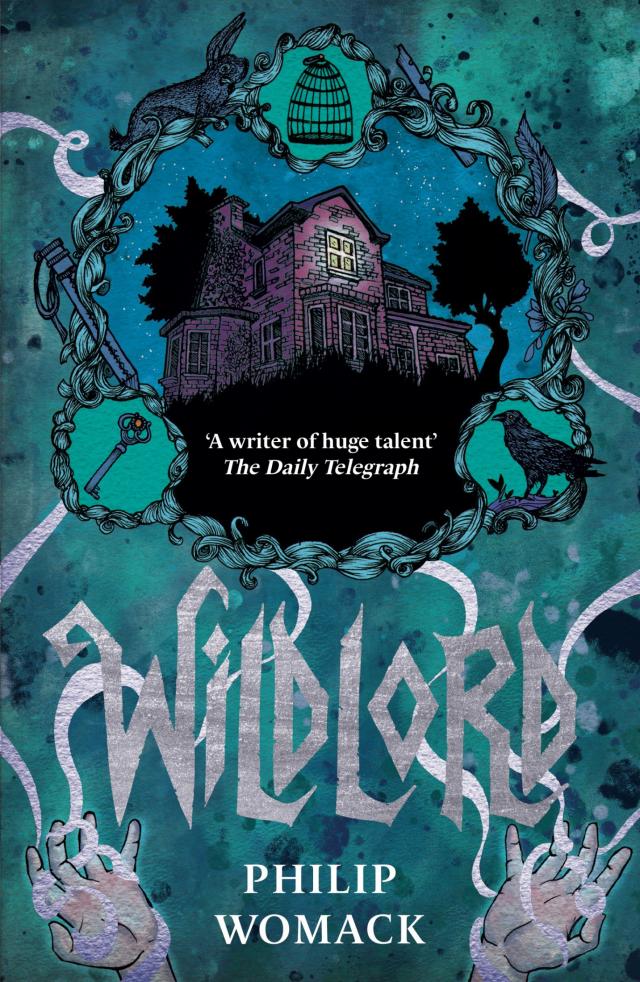
Wildlord, p.1
Wildlord, page 1


Also by Philip Womack
for children
The Other Book
The Liberators
The Darkening Path Trilogy
The Broken King
The King’s Shadow
The King’s Revenge
The Double Axe
The Arrow of Apollo
non-fiction for children
Write Your Own Myths
for adults
How to Teach Classics to Your Dog
WILDLORD
First published in 2021 by
Little Island Books
7 Kenilworth Park
Dublin 6w
Ireland
© Philip Womack 2021
All rights reserved. No part of this book may be reproduced, transmitted or stored in a retrieval system in any form or by any means (including electronic/ digital, mechanical, photocopying, scanning, recording or otherwise, by means now known or hereinafter invented) without prior permission in writing from the publisher.
A British Library Cataloguing in Publication record for this book is available from the British Library.
Cover by Karen Vaughan
Typeset by Kieran Nolan
Proofread by Emma Dunne
Print ISBN: 978-1-912417-97-1
Little Island has received funding to support this book from the Arts Council of Ireland
10 9 8 7 6 5 4 3 2 1
For my daughters
Xenia and Amalia Womack von Preussen
Chapter 1
14th April, 1846
Look long into the eyes of a Samdhya, he said, and you shall change. I looked long. I looked deep. Blossom fell from the tree, yet I did not notice. Already, I sense myself changing.
— From the diary of Margaret Ravenswood,
daughter of the Reverend Laurence
Ravenswood, Rector of Haughley
White Quad bell rang out into the mid-morning air, and Tom Swinton slumped down onto a wooden bench underneath a statue of his school’s founder. In front of him, a lone figure moved across the well-tended lawn, picking up and bagging detritus from last night’s Summer Ball. Tom was still wearing his dinner jacket, his bow-tie poking out of his pocket, his top shirt buttons undone.
He closed his eyes.
The party had continued into the early hours, and he’d fallen asleep on someone’s study floor, wrapped in a duvet. Sunlight had woken him at dawn. His friends were snoring gently, sprawled on their beds or on rugs. He’d gone to walk in the woods, which he always liked to do, taking with him a cold can from a vending machine.
He wanted to be alone among the trees. He hadn’t wanted to say goodbye to anyone. He’d wandered around the grounds for hours, making the fizzy drink last, waiting until he was sure all the cars, with their loads of schoolbooks and sports clothes and teenage boys, had gone.
Now, sinking back, the hard slats of the bench pressing into him, he counted the tolls of the bells.
8, 9, 10 …
It was almost eleven o’clock, and at some point he would have to properly face the fact that he was the only pupil left in the whole school, for the entire summer holidays.
A cough made him look up. A boy he didn’t recognise was standing on the gravel path in front of him. Almost eight hundred boys attended the school. Tom, being in the lower sixth form, did not come across many of the younger ones; but he knew most of them by sight. There was something distinctive about this one, though, and Tom wondered why he hadn’t noticed him around. He would have remembered him.
Tom couldn’t tell how old the boy was. He was very pale, with short black hair oddly combed so that it lay almost flat to his skull, and a snub nose. He looked like he might be in one of the junior forms, but a challenge in his eyes suggested otherwise.
Big fawn’s eyes and long trembling lashes. His uniform didn’t quite fit him, the purple jacket with its absurd gold stripes hanging off his shoulders; his tie in the school colours, green and grey, done up askew.
The badge on his blazer was odd. Instead of the school crest it showed a small square inside another square and another one inside that.
The boy was holding something to his chest, arms tightly across it. Tom wasn’t in the mood to be disturbed and savagely dragged a hand through his long blond hair, letting it fall across his eyes before blowing it away in displeasure. ‘Shouldn’t you have left?’ he snapped. ‘Everyone else has.’
The boy didn’t reply. Instead, he uncrossed his arms and offered up what was in his hands.
At first Tom ignored him. But there was a tightness in the boy’s shoulders. An insistence.
Tom took it carefully.
It was a letter. A heavy cream envelope of a type Tom hadn’t seen for years. The address was written in spidery ink.
‘Where did you get this?’ Tom straightened. ‘Did you take it from my pidge?’ The boy didn’t answer.
It was clearly addressed to him:
Master Thos. Swinton
Downshire College
There was no postcode, no county.
The boy shifted slightly, as if expecting something. Tom continued to stare at the letter. There was a silence around him; everything seemed so still, and he could hear no birds. Even the litter-picker seemed to have paused, deep in thought, and a cloud hung partway over the sun.
Thos? What did that mean? Nobody had ever called him Thos.
He turned the heavy letter over and was surprised to see that it was sealed with scarlet wax, which bore the imprint of a heraldic animal like a leopard’s head. He didn’t want to break the seal, but after a second’s thought, he slid his finger under it and opened the letter, leaving the body of the wax intact.
There was a single piece of thick card inside and two other small bits of orange card which fluttered out. Tom caught them without giving them a glance.
The writing was hard to decipher, flowery and scratchy, with flourishes in unexpected places. Somebody had spent a long time writing this letter. The boy, standing patiently in front of him, scratched his nose. Tom struggled to make out the writing.
Mundham Farm
Mundham
Suffolk
To my well-beloved cousin Thomas James Swinton,
You will come to stay with me, your dear Uncle James who has thought of you for so long and with such hope.
There is not much here but it is time for you to see and time for you to understand.
There are many things that I need you to do and many things that you shall need to learn.
You are the only other Swinton who remains.
Zita has arranged everything. You shall use the coupons herein. I am to hope that you shall know and do what is required. You shall be met at the post.
I remain, your most affectionate uncle,
James Swinton, Esquire
It was signed with an elaborate, curlicued swoop.
Uncle? Tom didn’t have an uncle. At least, nobody had ever told him he had an uncle. His father had been an only child. Could this James Swinton be a great-uncle? No, his grandfather only had sisters, and they’d changed their names when they’d got married, and as far as he knew those cousins were ranching in Australia or playing golf in Canada.
He looked more closely at the cards he held in his hand. A train ticket – a single one – and a receipt for it. Paid in cash, he noted. On the back of the receipt were scribbled the names of his stops, in different, more conventional handwriting.
It was for tomorrow. The 09.03 from Houghton to London, a quick change on the underground to Liverpool Street Station, where he had to get off, then a train on to Colchester, and then another change to a small station he assumed was in Suffolk. Mundham must be near enough to it.
What did ‘You will be met at the post’ mean? Maybe there was a post office outside the station where you waited. It could be local slang. He didn’t know anything about Suffolk. The whole thing was very strange.
Tom sensed a shadow passing over him.
He looked up. He had forgotten about the boy who’d delivered the letter.
But there was no boy. There had been no crunch of gravel on the path as he’d left.
The quad bell was still ringing: … 11.
The litter-picker finished his stretching and began to cross the lawn once more. Clouds scudded across the sky.
All this had happened in the gap between the bell sounding the tenth and the eleventh stroke.
Chapter 2
16th April, 1846
Today, he told me his name. As far as I can transliterate it here, it is Rohenga, which means in his tongue Hawk in the Mist. When he says it, my heart dances.
— From the diary of Margaret Ravenswood
The school’s emptiness flowed around Tom like an echo, pouring down the colonnaded sides of White Quad and washing over the stone cloisters. In the shade of the single plane tree, he gripped the letter tightly and then, fearful of crumpling it, smoothed it out flat on his knees. His dinner jacket felt hot on him, and he shifted it off, letting it fall in a rumpled mess to his side.
Where usually there would be the shouts and stampedes of boys on their way to lessons or games or meals, now there was nothing. Only the college mowers were humming distantly. A master, white head down and gnarled hands held tightly behind his back, black gown flapping, hurrying to some not-wished-for appointment, caught sight of Tom. He paused, knuckled his hands on his hips and shouted, ‘Go and get changed, Swinton, you’re a disgrace,’ before scurrying onwards in the direction of the headmaster’s house. Tom stood. He would go back to his room.
A couple of house matrons were chatting by the door to Tom’s boarding house. One of them, with a rabbity face and a faint antiseptic scent of the sanatorium, eyed him askance and looked like she was about to say something. Tom made a mock bow, grabbed her by the shoulders and kissed her lightly on the cheek, skipped down the stairs and passed through the heavy oak door.
Eight weeks of holidays stretched ahead of Tom. Eight weeks in which he was bound to stay here in school. His nearest friend lived a twenty-mile drive away, beyond the Downs; but Tom couldn’t drive and didn’t have a car. Anyway, Fred was doing internships at the local newspaper office and with the borough’s MP. Fred had his sights set on Oxbridge – he always had done. ‘And when I’m not working, I’ll be revising,’ he’d said the day before, potting a ball as they’d played a final game of pool. ‘We need these holidays to consolidate for our exams. Beat you again.’
Tom wished he had his own sights set on something. Instead, when he looked into his future after school, he just saw a blank space.
He stomped through the empty boarding house to his tiny study and slumped onto the hard bed.
An hour or so later, a pasty, spotty face poked round the door, staring through thick-rimmed glasses and topped with a mass of oily, unruly brown curls.
Tom, showered and changed into blue jeans and an old white T-shirt, was sitting on his wooden chair by the window. His room looked out onto School Quad, and Tom was alternately gazing out at the bricks and studying the letter. He placed it as unhurriedly as he could into his pocket and kicked his shabby canvas trainers against each other, nonchalantly.
‘Swinton, Fletch wants you,’ said the face, scratched its nose, scowled and vanished, banging the door shut as Tom shouted, ‘You could have knocked!’ after him.
Tom caught up with the third-former scurrying along the lower-sixth-form corridor, which still stank of spray deodorants and mustiness. All the doors to the narrow, Spartan study bedrooms were open; and all of them were empty, the posters recently torn down, leaving tiny imprints behind them where they’d been stuck up with Blu Tack or tape.
‘Why does he want me?’
‘Didn’t say,’ said the boy, who was Colin Fletcher, the youngest son of Tom’s housemaster. They came clattering down the wooden stairs and reached the House Hall.
A tall mullioned window lent brightness to the rows of boards showing house honours, names painted onto wood, and the rack of pigeon holes, all now empty.
The boy hung for a moment on the banisters and gaped at Tom, until Tom shooed him away.
He checked his pidge, as if there might be something there to explain the letter; but all that was in it was a pink form he had yet to fill in about his university choices for next year. He put it back without looking at it.
A second later he knocked on Fletcher’s door and heard the housemaster’s deep response: ‘Enter!’ There was rather too much emphasis on the first syllable. Fletch sometimes liked to showboat, and Tom was one of the few who didn’t humour him. He went in sulkily.
The housemaster was ensconced in his large, comfortable brown leather armchair, which took up most of the office. He was a bulky man, with sparse grey hair and red-veined cheeks. Shining rugby trophies cluttered the shelves, which were largely bare of books. A plant pot occupied most of the remaining space. The very small window was wide open.
Fletcher was in his shirtsleeves. A fan on his desk was purring, but sweat patches were showing under his arms, darkening his blue shirt. Every time the fan moved across him, his tie, hanging loosely from an open collar, flapped.
‘Could do better,’ said Fletch to himself, in his peculiarly nasal voice, hardly looking up from the reports he was writing with a thick fountain pen. ‘Sometimes I wish I could write what I really think. But I don’t think parents want to hear that, do they, Swinton?’ Fletcher placed his pen on top of a pile of papers as if it were a weapon. He folded his arms deliberately. ‘There have been rumours this term – which I am willing to believe are only rumours. You have one year left here at Downshire and you are all set to do well in your A Levels. There are universities to apply to, internships to get. I am willing to give you the BOD.’ He liked to use sporting references.
Tom said nothing; he crossed his legs at the ankle.
‘But –’ and here Fletcher pointed his large nose at Tom, beetling his brows together ‘– if, whilst you are here under my guardianship over this holiday, I find any evidence of anything – anything – that might point to the truth of these rumours, I need leave you in no doubt that school rules will apply.’ He paused significantly. If his eyebrows could get any closer together, Tom thought, they might join up and become one. ‘You will be considered for expulsion.’ He let the word hang in the air. His tie flapped, as if in emphasis. ‘For the moment, though, you will be gated and can only leave the school grounds with adult’ – a word he unnecessarily stressed – ‘supervision. Last chance, Swinton. Last chance.’
Tom thought about the half bottle of whiskey that he and a friend had snuck in half a term ago one Saturday afternoon. Fletch must have smelled it on them at roll call before dinner. He gave his best ‘I don’t know what you’re talking about’ grin.
‘Sir – it’s the holidays. Aren’t I even allowed to go into town on my own for a kebab?’
Fletch furrowed his brow even further. ‘No, Swinton, you are not allowed to go into town for a … kebab. Go on healthy walks. Admire the rolling countryside. Perhaps even you, Tom Swinton, could find it in yourself to use the extensive sports facilities. And always, always, always sign in with me, after breakfast, at lunch, at 6.30pm and at 10.30pm. Do you understand me?’
A giggle sounded behind him, and Tom knew that the Fletcher boy was hanging about outside, listening in.
Prison wasn’t too strong a word. ‘That’s …’
‘That’s that, Master Swinton. I can’t have you causing me trouble during the holidays as well as during term time. Now I’ve got to write these bloody reports. I’ve done yours already, before you ask.’ With a gesture, he left Tom in no doubt as to the content, turning it into a dismissive motion, and Tom departed with as much dignity as he could hope to muster.
The Fletcher boy was hanging about in the corridor. Tom resisted the urge to glare at him.
He remembered the letter in his pocket and turned round to knock on the door again. Could he show it to Fletcher? It was a way out, after all.
One look at the third-former picking his nose firmed his resolve.
Chapter 3
16th April, 1846
They have many names for themselves. Sometimes they are the Storm, sometimes the Deep. When the Wildlord rides, they are the Wildmark.
— From the diary of Margaret Ravenswood
Back in the housemaster’s office, Fletcher took and read Tom’s letter carefully. ‘This looks like you concocted it in the art room.’
‘It was in my pidge, sir,’ said Tom, knowing he couldn’t tell the truth about the strange boy with his tie askew and the way that time had seemed to stop.
Had stopped.
No, it couldn’t have done. The bell tolled again in his mind, and the boy’s dark eyes flashed at him.
‘We–ell … there’s no postmark or stamp. And there’s no phone number on this letter, Swinton. Let alone an email address. I can’t contact this man who says he’s your uncle. I can’t let you go.’ He steepled his hands together, cracking his large beefy knuckles. ‘Much as I would like to have you off my conscience.’
‘But the train – it’s tomorrow morning.’
‘I will have to write to him myself and receive a confirmation from both him and from your guardian. You say yourself that you haven’t heard of this James Swinton.’
Tom shook his head. ‘I … I remember something. James Swinton, my uncle. I remember dad talking about it …’ He trailed off. The truth was he didn’t. There had been some vague talk in the family about a Suffolk farm. What had it been called? Mundham? It sounded fairly familiar. As he watched Fletch frowning, he dimly caught at the back of his mind the sound of his mother mentioning it.
His father had never talked about it, though, or any of his relations. And now he’d never have the chance to ask him, as both his parents had been dead, drowned, at the bottom of the Atlantic Ocean, for the last five years.