Impossible creatures, p.1
Impossible Creatures, page 1


Praise for
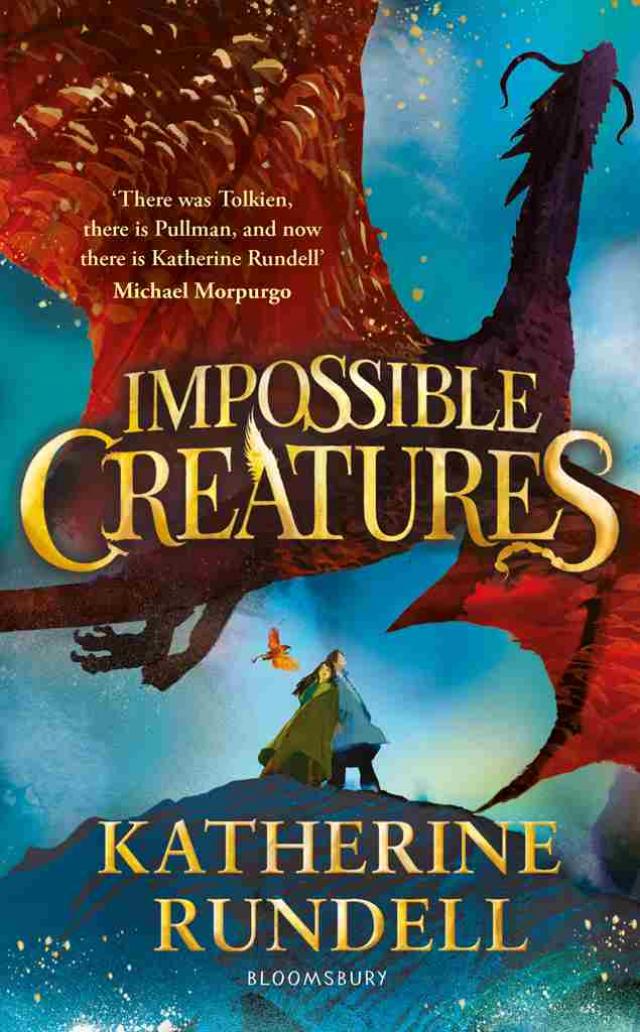
‘There was Tolkien, there is Pullman, and now there is Katherine Rundell. Wondrous invention, marvellous writing. This book is her best yet, and that’s saying something’
Michael Morpurgo
‘Katherine Rundell is a phenomenon. She not only understands what fantasy is for and why children (and the rest of us) need it, but she crafts original and brilliant books that delight readers of all ages and kinds, while stretching our minds and filling our hearts’
Neil Gaiman
‘I love Katherine Rundell’s writing … Readers who already know her books will seize this with delight, and new readers will love it and demand all her others at once’
Philip Pullman
‘A marvellous imaginative fantasy told with great style and sparkle – a book to race through in a day and keep for a lifetime’
Jacqueline Wilson
‘Fantastically exuberant, wildly imaginative, impossibly brilliant. Rundell’s best, which is something to be marvelled at. It made me want to yell, or laugh, or bite something’
Kiran Millwood Hargrave
‘Between the covers of Impossible Creatures is a world as enchanting, as perilous, as richly imagined as Narnia or Middle Earth’
Frank Cottrell-Boyce
‘A soaring odyssey of burning fierce heart and wit’
Piers Torday
‘A menagerie of delights. So packed with magic you’ll want to take notes. Impossible Creatures is a world you’ll want to move into’
Patrick Ness
‘I savoured every moment of Impossible Creatures. An absolutely magnificent story!’
Abi Elphinstone
‘A rare and remarkable feat of glittering imagination from a truly masterful storyteller. The best thing since Pullman’
Catherine Doyle
‘A thrilling and page-turning epic … My Book of the Year’
Lauren St John
Books by Katherine Rundell
Rooftoppers
The Wolf Wilder
The Explorer
The Good Thieves
Impossible Creatures
For younger readers
One Christmas Wish
The Zebra’s Great Escape
For adult readers
Why You Should Read Children’s Books, Even Though You Are So Old and Wise
Super-Infinite: The Transformations of John Donne
The Golden Mole and Other Living Treasure
Edited by Katherine Rundell
The Book of Hopes
In memory of Claire Hawkins, my great-aunt, who lit my childhood
‘The griffin is both a feathered animal and a quadruped;
its body is like that of a lion, but it has wings and the face
of an eagle.’
Isidore of Seville, Etymologies (c. 600)
‘His mouth is death and his breath is fire!’
The Epic of Gilgamesh (Mesopotamia, c. 2000 BCE),
probably the earliest written reference to dragons
‘I sing the progress of a deathless soul.’
John Donne, Metempsychosis (1601)
THE
GUARDIAN’S
BESTIARY
There is a secret place in our world that is care fully hidden, to keep it safe from us. It’s a wild magnificence of a place: a land where all the creatures of myth still live and thrive. It is known as the Archipelago: a cluster of thirty-four islands, some as large as Denmark, some as small as a town square. Across the islands, thou sands of magical creatures run and fly, raise their young, grow old, die and begin again. To us they’re half forgot ten, and were long ago dismissed as children’s stories. But we have not destroyed them; they survive. They are plentiful, and shining, and real. It is the last surviving magical place.
Al-miraj
Al-mirajes are horned hares of dazzling beauty. Their ears are long and pink on the inside, and their horns pure gold. During the mating season, where the al-miraj treads, fresh shoots of greenery rise from the earth; they can carpet a barren field with grass within an hour. The al-miraj is said to seek out the valiant, the wise and the good. Queen Arian of Lithia once sought to give one to her fiancé, only to see the creature shun her suitor and joyfully greet her maidservant. She married her maidservant instead and they lived happily ever after, with a garden full of gold-horned hares.
Avanc
The avanc is a swamp-dwelling carnivore, resembling a fanged beaver. The teeth of the avanc, which are bone-white and pointed like pins, grow an inch every day, and they keep them trimmed and sharpened against rocks, trees and occasional humans. The softness and lustrous beauty of their fur can lead children to take liberties. Those children who do so, do so only once.
Borometz
Also known as the ‘vegetable lamb’, the borometz grows from a green stalk, to which it is tethered by a tendril. The lamb reaches one foot in height; its skin is green and its wool is white. If the lamb eats all the grass within the reach of the tendril, both the lamb and the plant will die. For this reason, many people in the Archipelago carry seeds, to plant around the borometz’s stalk if they see one. Their wool, given freely to those they trust, makes the softest cloth in the known world; cloth which lasts hundreds of years, and smells very faintly of the earth.
Centaur
(female: centauride)
Centaurs have the body of a horse and the torso and head of a human. While they are skilled artisans in a variety of crafts, much centaur culture focuses around food, because they must eat a dozen times a day, to fuel the needs of their bodies and tremendous brains. They are great culinary invent ors, and centaur feasts take place at every full moon, spread out under moon light. They serve forest fruits, piled three feet high, and ferocious crab-apple spirits, and the feasting lasts all night and into the next day.
Chimaera
The chimaera resembles a lion, but has a second head, that of a goat, and a tail which ends in the face of a snake. These three faces all have individuated brains, nervous systems and strong opinions. This makes it difficult for the chimaera to achieve as much havoc as it other wise might, as it generally fails to agree with itself as to what to do next.
Dragon
There are thirty-seven species of dragon in the Archipelago. The largest – the red-winged dragon, which is black with a scarlet under-wing – is as large as a cathedral. The smallest, the jaculus, can sit comfortably on the joint of your thumb. The yellow dragon, slim-winged and long-tailed, is the fastest in the sky, while the bronze-tailed aquatic dragon is able to breathe underwater, and has been known to spend its entire adult life beneath the ocean, erupting to the surface only to hunt occasional sailors. The silver dragon, which can live up to four thou sand years, is thought to be the oldest creature in the world. It is unpredictable in temper, as befits one who has seen so much.
Griffin
Griffins have the body, tail and back legs of a lion, and the head, wings and front claws of an eagle. Though they do not speak aloud, they learn astonishingly fast, and can under stand the entirety of a human language within days. When fully grown, their wingspan is broad enough to shelter a child underneath it. In cold weather, their bodies radiate warmth. The griffin is more reliant than any other creature on the glimourie in the soil and the air; they are among the world’s most magical creatures. [Addendum, by Frank Aureate: For the last five years, griffins have become rarer and rarer. The reason is unclear, but it is possibly connected to a fading in the glimourie. Their status now is believed to be near-extinct.]
Hippocamp
Hippocamps are the true sea-horses of the oceans. They live in herds of ten to twenty; the male is larger than the female, but the female is swifter. They range in colour from emerald green, to grey, to, in the north-west, the shining pink of coral. Some are tamed and ridden by nereids. All boats in the Archipelago must, by law, run on wind or sun, so that the water will remain unpolluted, and the young hippo camps (known as ‘hippolines’) can grow into their full lustrous beauty.
Kanko
A foxlike creature the size of a mouse, the kanko’s tail is split in two, allowing it to perform extraordinary feats of balance. Also known as ‘light foxes’, their saliva has luminescent properties, and has been used in paintings, particularly in Japan, where they origin ate. They have a rich, attentive intelligence despite their size, and are known to bring luck. The nest of a kanko, there fore, mustn’t be disturbed; but they have been known to nest in inconvenient places – in shoes, hats, pockets, and, once, in the beard of a gentle man on the day of his wedding.
Karkadann
Karkadanns resemble unicorns, if unicorns had vicious souls and canine teeth. One of the few creatures in the Archipelago who kill for sport as well as food, they eat meat, prefer ring human flesh, and grass, for digestion. The hide of the karkadann ranges from pure black to purple, and the skin sags from their bones. The horn is black, and the tip carries a poison which can cause agonising gangrene, paralysis and death. They can be kept at bay with the horn of a unicorn, but, as you are extremely unlikely to have a unicorn to hand, that is frankly of limited help.
Kludde
A dog the size of a bear, the kludde is black except where, in place of ears, it has a pair of flames. It uses the lights of its ears to attract its prey – largely deer, wild cattle and al-mirajes – and then devours it. It can be identified from a distance by its breath, which resembles the shriek of metal on metal. The only way to kill a kludde is to extinguish its flames with wet e arth or sand. Kluddes live primarily on islands uninhabited by humans; very few Archipelagians will see one in their life times. Those who see them do not forget. [Addendum by Frank Aureate: unless they have been eaten, in which case they presumably do.]
Kraken
The oldest of the sea creatures, krakens have been traced back as far as the Cretaceous period, co-existing with the Tyrannosaurus rex. Their tentacles range in number from eight to forty-six, depending on the subspecies. They are terrifying in their moments of hunger: there have been accounts of krakens consuming as many as four hundred sailors in a single day, and the whirl pool created by their tentacles can pull ships of enormous size to the sea-floor. Krakens do not in general migrate, and remain in the body of water they were born in, so sailors in possession of good maps can usually evade them; but those who sail without maps take their lives in their hands.
Lavellan
The lavellan looks like a small water shrew. It features in the satirical song: ‘Let him not go away from the houses, to moss or wood, lest the Lavellan come and smite him.’ This is not a good song, but it is a good warning. The lavellan can poison a water source by swimming in it, and can, despite its small size, kill an adult human with its teeth. The lavellan has no interest in harming humans unless provoked, but its definition of ‘provoked’ is a broad one and can include sniffing, laughing and all forms of interpretive dance.
Longma
A winged, scaled horse – often green or brown with a black under belly – of breathtaking beauty and strength. Some longmas go their entire lives without touching the ground. Sky-ready like no other creature, they wash by seeking out rain clouds and flying slowly through them, their scaled wings outstretched. A longma is the only creature in the world that gives birth in the air: the mother flies as high as she can into the sky, so that when the foal falls from her womb, it has as long as possible to unfold its wings before it hits the ground. Longmas should be treated with caution: only a very small number develop bonds with humans. Even then, those humans occasionally wake to find them selves being eaten in small ways, which are nonetheless inconvenient – a finger, for instance, or half an ear – because there is no such thing as a truly tame longma.
Manticore
The manticore has the tail of a scorpion, the face of a human, the teeth and body of a lion, and the personality of a self-righteous politician. Some sub-species are winged. Manticores, like karkadanns, are one of the very few creatures who will attack humans on sight, even when not in need of food. They lie and kill for the pleasure of it. They smell of decay.
Mermaid
(cf. also merman, merfolk; a newborn merchild is a merbaern)
Most mermaids live in the northern waters of the Archipelago. Some clans, such as the Marian tribe, grow tails as long as thirty feet, and each mermaid tail, whatever their length, has 40,000 muscles (humans, in comparison, have about 650 in their entire bodies). Many merfolk are musicians, and have invented a range of underwater instruments of great sweetness and beauty. Some of their songs, shared with humans, have entered human tradition: Vivaldi is thought to have borrowed many of his compositions from the merfolk.
Nereid
It is unwise to mistake a nereid for a mermaid; they object, and their objections can be perilous. Although they live underwater, they have no tails. Their hair and fingertips are silver, and their pale skin has a silver sheen. Their speaking voices are famously mesmeric – they’re said to have taken their language straight from the music of the sea. Although they are entirely capable of walking on dry land, they do so only in cases of urgent need. Found primarily in the south seas of the Archipelago, they are a fiercely logical people, but their logic is the logic of the ocean, beyond the understanding of humans. The human populations of the Archipelago treat them with awe, and keep their distance; the expression ‘as unknowable as a nereid’ is a common one in the islands.
Ratatoska
(pronunciation: rata-TOS-ka. Alternative spelling: ratatoskr)
Akin to large squirrels, green-furred with a short horn, the ratatoskas spread news across the Archipelago. They know more of the world’s secrets – the gossip, the tall tales, the truths and half-truths and quarter-truths – than anyone else. Though physically harm less, they can, when young, be giddy chaos-merchants with a liking for mischief. If you wish to spread a piece of news, and are not too concerned about accuracy, tell a ratatoska.
Sphinx
Sphinxes are gifted mathematicians and scholars, ruthlessly loyal allies and implacable enemies. The tooth of a sphinx, held in the mouth of a human, allows its owner to under stand any language; a lick from a sphinx can heal most wounds. Originally found primarily in Northern Africa and South-East Asia, sphinxes migrated across the world before coming to rest on the mountainous peninsula of the Island of Lithia. Those wishing to visit the sphinxes’ mountains should be aware that, if you should fail to answer the riddle they pose, the sphinx has an ancient right to eat you.
Twrch Tryth
(pronunciation: twOOrk troeeth)
A blue-black boar, said to have been ridden, once, by King Arthur. Its fur shines iridescent in moon light. The boar can grow as large as a rhinoceros, and is capable of crushing those who frighten or anger it, but is gentle and sweet-tempered with children. It has been known to shelter swallows beneath its belly and in its armpits during rainstorms. Known as the warrior-boar, the twrch tryth will fight for those it loves. Clumsy on the ground, they are exquisitely elegant in the water, and can swim the length of the Archipelago without pausing for a single minute.
Unicorn
Born coloured pure gold, unicorns turn silver in their second year and white in their fourth. They prefer wooded areas, and soft turf underfoot. Able if left untroubled to live more than three hundred years, unicorns can thrive on grass and shrubs, but they love herbs – lemon-grass, thyme and, most of all, mint. Their breath can endow humans with courage. Hairs from their tails and manes can, when woven into band ages, cure fatally infected wounds; they have been known to walk battle fields, breathing life into the fallen. There have, throughout history, been accounts of people riding unicorns, but it is vanishingly rare; most who have tried have found them selves care fully and politely trampled into the ground.
THE BEGINNING
It was a very fine day, until something tried to eat him.
It was a black dog-like creature, but it was not like any dog he had ever seen. It had teeth as long as his arm, and claws that could tear apart an oak tree.
It says, therefore, a great deal in Christopher Forrester’s favour that he refused – with speed and cunning and courage – to be eaten.
THE BEGINNING, ELSEWHERE
It was a very fine day, until somebody tried to kill her.
Mal had returned home from her journey, flying back from the forest with arms outstretched and coat flapping, buffeted by the wind.
Mal Arvorian could fly only when the wind blew. The weather that day was perfect – a westerly breeze that smelt of the sea – and she was sky-spinning, twisting in the cold air. Her flying coat was thick, and too big for her, and she wore it with the sleeves rolled up four times. When the wind was up – it didn’t need to be strong, but some wind was necessary – she could catch at the corners and open it, like wings, and feel the breeze lift her off her feet.
That day she had flown over treetops, her shoes brushing the tips of their branches, and swooped low, causing a herd of unicorns to scatter.
In the kitchen, her Great-Aunt Leonor had grumbled at her cold hands, and given her a cup of hot cordial, when there was a knock on the door.