

First string future, p.1
First-String Future, page 1


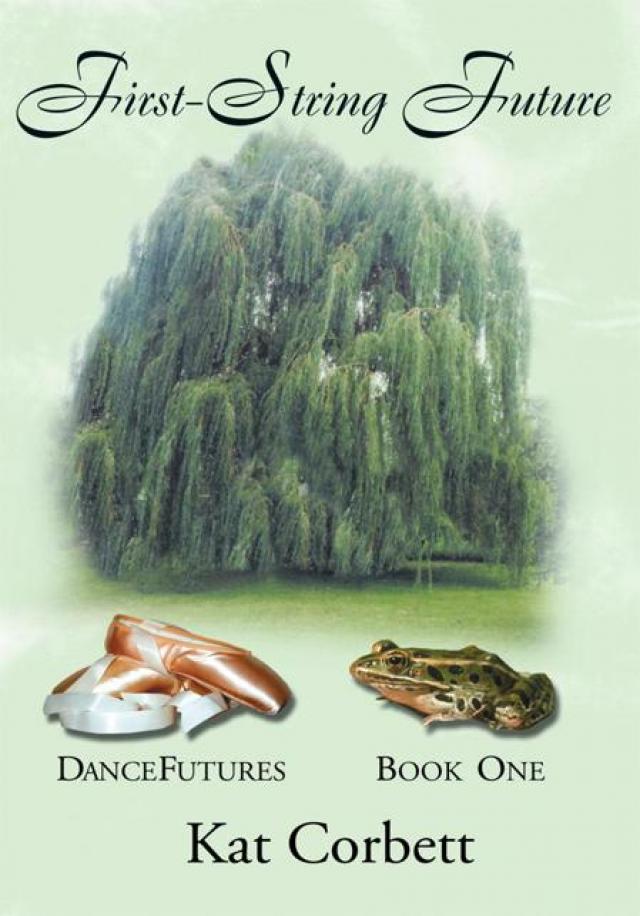
DANCE FUTURES
“I will lend you the wings of the future.” Robinson Jeffers, 1887–1962
BOOK ONE
First-String Future
BOOK TWO
Future Perfect
FIRST-STRING FUTURE
Kat Corbett
Writers Club Press
New York Lincoln Shanghai
First-String Future
All Rights Reserved © 2000 by Kat Corbett
No part of this book may be reproduced or transmitted in any form or by any means, graphic, electronic, or mechanical, including photocopying, recording, taping, or by any information storage retrieval system, without the permission in writing from the publisher.
Writers Club Press an imprint of iUniverse, Inc.
For information address: iUniverse 2021 Pine Lake Road, Suite 100 Lincoln, NE 68512 www.iuniverse.com
ISBN: 0-595-12738-X
ISBN: 978-1-4697-4960-0 (eboo)
Printed in the United States of America
Contents
DEDICATION
EPIGRAPHS
ACKNOWLEDGEMENTS
CHAPTER ONE
CHAPTER TWO
CHAPTER THREE
CHAPTER FOUR
CHAPTER FIVE
CHAPTER SIX
CHAPTER SEVEN
CHAPTER EIGHT
CHAPTER NINE
CHAPTER TEN
CHAPTER ELEVEN
CHAPTER TWELVE
CHAPTER THIRTEEN
CHAPTER FOURTEEN
CHAPTER FIFTEEN
CHAPTER SIXTEEN
CHAPTER SEVENTEEN
CHAPTER EIGHTEEN
CHAPTER NINETEEN
BIBLIOGRAPHY
DEDICATION
For my Mother,
who loved to dance
and who had many strings to her bow.
EPIGRAPHS
“Will you, won’t you, will you, won’t you, will you join the dance?”
Alice’s Adventures in Wonderland
Lewis Carroll, 1832–1898
“The more helpless a creature, the more it is entitled to protection from cruelty.”
Mahatma Gandhi, 1869–1948,
political and spiritual leader in India
ACKNOWLEDGEMENTS
Thank you, thank you, thank you to the many people who helped make this book possible! First, to Southern Ballet Theatre in Orlando, Florida, for allowing me to “hang out,” pad and pencil in hand, and to the dance students and their parents who answered my many questions. Special thanks to the Rinke family—to daughters Liesl and Heidi, beautiful dancers both, for being First Readers of this book and to parents Ray and Jill for sharing details about their ballet-centered lives. Thanks to all my other First Readers for their time and helpful comments. Stacey Price, now in North Carolina, and Miranda Wenaus, in New York State, are both serious dance students. Amanda Bloor became a dance student after reading the book! Stacia Tanner provided details about middle-school science fairs. Adult First Readers Ed Bloor, Sarah Medvitz, Mary Schneider, and Hillary Corbett all offered invaluable insights.
Pats and treats to greyhounds Blue Dog and Kari for the interview they granted me, and thanks to their “mom,” Phyllis Zunk, who interpreted for us. Along with their speedy friend Mach I, they really did appear onstage! Kaitana Magno, one of the student handlers, shared what that experience was like.
Mike Sergeant, of Southeastern Guide Dogs, and Rachel Bader, of the Center for Independence Technology and Education, whom I met with her guide dog, Jester, taught me about Orientation and Mobility training. Thanks to both! The guide dog in the book, Zarhan, is named to honor the memory of the beloved companion of the Dvoryadkin family of Krasnoyarsk, Russia.
Mary Gerding, director of the no-kill Leesburg Humane Society shelter, made a perfect model for Mary in the book. (So, of course, did the real Ramona for the goat!) I have the greatest admiration for Mary, who copes miraculously with a constant oversupply of animals and undersupply of funds.
Many thanks to Gene Pickler, of the Orange County Public Schools, for information about dissection and exam policies in the Orlando area schools. He told me that seventh graders were his special love, and I could tell it was true!
The education department staffs of both PETA (People for the Ethical Treatment of Animals) and NAVS (the National Anti-Vivisection Society) were most cooperative and enthusiastic about providing materials relating to dissection in schools and other animal-rights issues. Thank you for your help!
I want to express my deep appreciation to some of my colleagues: Navin Patel for cover advice, Tom Canuelas for detail work on the photos, Nancy Tobin for the frog image, and Ed Bloor, author of Tangerine and Crusader, for his ongoing encouragement.
Finally, thanks SO much to Geri Bugge, a Southern Ballet Theatre volunteer, who kindly gave me the very last of the special T-shirts—the one featured in the story. I’m so happy to have it!
PHOTO CREDITS Weeping willow tree—Elinor Masson Ballet shoes—Hillary Corbett Author photo—Mary Schneider
CHAPTER ONE
HAPPY NEW YEAR
It’s never seemed to me that the new year begins on January first. As far back as I can remember, my life has been measured in school grades, so to me, the real “New Year’s Day” is the first day of school. In Orlando, Florida, this comes in August, usually in a heat wave. There may not be New Year’s fireworks—though when my sister and I were little, Mom was ready to send up some the day we went back to school—but there’s something just as exciting about starting a new grade. What will it be like? Will someone new and interesting show up? What totally amazing things will happen this year?
For me it’s a double New Year, because I start a new level in ballet at the same time. Each year I wonder if I’ll be able to learn the things I’ve watched the older girls do. When I look back, though, I see that I’m a long way ahead of the girls starting the level I’ve just finished. So I figure with enough sweat, I’ll get it.
Even my own personal new year is not far off when school starts. On September seventh this year I’ll be a teenager—I can’t wait!
So why, on this first day of seventh grade and Level Seven, with my thirteenth birthday in sight, am I dragging my clothes on alone in the dressing room at Southern Ballet feeling majorly depressed? I’ll tell you.
Everything started out fine this morning. The corridors of Oakwood Middle School had that first-day-of-school aroma of floor wax and new paint, and when I opened my backpack at my new desk, I inhaled the get-to-work tang of freshly sharpened pencils and brand new erasers—both on my list of favorite smells. I could hardly wait for class to start. Then our new first-period teacher walked in, and everything went downhill from there.
Even her back, as she silently wrote Mrs. Stengle on the chalkboard and punched an angry period after it, looked mean—stiff and bony below a straggly bun of faded yellowish-gray braids. When she turned around, her hawk-nosed face looked scornful. She informed us that she’d been a high school science teacher until this year, and the way she said it made it pretty clear that changing to middle school had not been her idea. Her plan seemed to be to treat us as short ninth graders. She told us it was not too soon for us to start preparing ourselves for high school and that she would expect “mature behavior” at all times. Then she handed out the life science textbooks, and seventh grade—for better or for worse—began.
I stood my book up on my desk so I could sneak a peek through the rest of the chapters without Mrs. Stengle seeing me paging ahead. Lots of interesting stuff to come, I saw. There was a cute picture of little triplets in the unit on genetics, some leaping dancers—cool!—introducing the human body, and…oh, no!…About two-thirds of the way through the book there was a photo of a beautiful frog—with his whole front torn open and pinned back to show his insides. His spotty legs, undamaged, were as beautifully muscled as those of the dancers a few pages back, and for his size he probably could have outleapt them all. Who had been so cruel as to take him from his pond for this? Then the real horror hit me. Maybe WE were going to have to cut up REAL frogs this year! Well, not me. They couldn’t make you, could they?
I lost all track of the lesson as I wrestled with what I should do. Even as I burned over what was being done to poor frogs in the name of seventh-grade science, I broke into a cold sweat thinking about refusing to take part in it. I don’t like confronting anyone, and I’m pretty shy about talking to grownups about anything. This was going to involve both—confronting a grownup—and who worse than Mrs. Stengle? But if I said nothing, I’d have to do the dissection when the time came. THAT was unthinkable.
So right after Mrs. Stengle gave us a huge dose of homework and dismissed us to our next class, I grabbed my backpack and headed up to her desk before I could chicken out. I wanted to get this over with before her next class came in—I didn’t need an audience.
“Excuse me, Mrs. Stengle,” I began. “I’m Tori Baylor. May I ask you a question?”
“What is it, Victoria?” she asked, looking me up and down coldly. “Make it quick, please.”
“I…um…as I was closing my book, I noticed a picture of a dissection. Will we actually do that this year in class?”
“Of course. I always do at least one dissection in my classes. What is the problem?”
“I don’t want to do dissection, Mrs. Stengle.” I swung my backpack onto my shoulder and gripped my icy hands behind my back.
“You’ll do many of them when you get to high school, so you might as well get used to it. It’s silly to be squeamish, Victoria.”
“It’s not that, Mrs. Stengle. I just…feel wrong about it. I mean, I don’t think people should do that to frogs.”
“It doesn’t hurt the frogs, Victoria,” she said with a superior smile. “They’re already dead.”
“But they wouldn’t be dead if schools didn’t use them for dissections.”
“They’re only frogs. They don’t know the difference. They don’t know anything,” she replied with that same I-knowbetter-than-you smile.
“But they have a right to live,” I said, feeling desperate. This was not going well at all.
“And I have a right to teach this course without your advice,” Mrs. Stengle said. “If you want to miss the dissection and take a failing grade, that’s your right. So we’re even.” She turned away from me and started writing on the board.
Stunned, I somehow got myself out the door. I had expected an argument—after all, someone who does dissections must believe in them—but I hadn’t expected a teacher to be rude. Never in all my school years had a teacher spoken to me that way. All my teachers have liked me. Now I felt as though I’d had my face slapped, and by someone who didn’t know me—didn’t even want to know me. Making my way through the halls, I fought back tears of shock. What had I said? Had I been rude and made her mad? I didn’t think so, going over the scene. An argument raged in my head. First I scolded myself: You were stupid to say anything! You’re just no good at this kind of stuff. You should have kept your mouth shut. Then I answered back: Wrong! I should have said a whole lot more! I should have said…Oh, what’s the use? I’d only have gotten myself into trouble. As if I weren’t in trouble with the Dragon Lady now for the whole year anyway—maybe longer!
Of course I stewed about the situation all day long. Would I fail science if I didn’t take part in the dissection? Couldn’t I learn about a frog’s insides by studying the book? After all, I saw that we’re also going to learn about our own insides, and I don’t suppose we’ll be dissecting any small children.
Round and round my brain went until by the time I got to ballet, I was good for nothing. Luckily all the teachers there know all of us. A new dance teacher would have wondered why I wasn’t in Level One with the beginners. So although I had a rotten class and made so many flubs I was tired of hearing my name, no real damage was done. Just a few dents to my outlook on ballet, as well as on school and on life in general.
So here I am, glooming to myself in the girls’ dressing room, all alone as usual. The alone part is another problem—I don’t have a best friend I can laugh things off with. Like today, if I’d had someone I could have blown off the whole affair with, I wouldn’t have felt bad all day. But when you spend all your afternoons and evenings at ballet, you can’t do any after-school stuff. So you don’t get to know anybody well enough to be best friends. Oh sure, I have kids I sit with in the cafeteria, but they all have their own friends that they do things with outside of school.
There’s no hope of a friend in my neighborhood, either. The houses around us are old, and so are the people who own them. Some of them have their married kids living with them, but their grandkids are all little—babies and preschoolers that my sister and I baby-sit.
Roni and I get along pretty well for sisters, but we like different things. Plus she’s older—there’s only a year and a half between us, but we’re two years apart in school because of when our birthdays fall. She’s starting high school this year, so her life will be even more different from mine. And naturally her friends aren’t going to want a seventh grader hanging around them. Most of them think I’m weird anyway just because I’m a dancer.
You might think I’d have friends from ballet, but that doesn’t work either. I do spend a lot of time with those girls, but we can’t talk to each other in class. We have only the few minutes before and between classes. After class, parents are waiting to rush us off to homework and bed. And since we come from all over the city, we all go to different schools. So we really don’t know each other except as fellow dancers.
I’m about the only one who ever uses the dressing room. The other girls always have rides home, so they come and go in their dance clothes. I do, too, for evening classes when Mom or Dad can drive me. But for afternoon classes on days when Mom’s working—she’s a substitute teacher—I have to take the bus home. So I grab a quick shower to rinse off the sweat and get back into my school clothes.
Sweat? Rats! I left my sweat towel hanging on the barre in Studio
2. I’ll have to go get it or it’ll have disappeared by tomorrow. Well, there’s plenty of time—I already missed the first bus because class ran over. I like rambling through the empty halls and studios this time of night, when the teachers are on supper break. The smell of pizza wafts from one of the offices, and my stomach gives a loud growl—time to break out my snack-attack apple. There must be a rehearsal going on. I can hear a muffled piano in the distance and a faint voice hollering orders that must be far from faint up close. The echoing booms are the Company dancers hitting the floor between leaps. I wish I could go watch. If I can make it through Level Eight, I can become a trainee and start dancing with them—and learning what being a dancer is really like. If that goes well, I’ll get to be an apprentice. Then, if I’m good enough, I might be invited to join the Company. That’s a lot of ifs, though…
The lights are off in Studio 2, but shafts of sunlight slant down through the windows above the long mirror wall. In the silence a girl is dancing alone, her blond hair not in the usual ballet bun but falling loose below her shoulders. Her green eyes are serious, her pale mouth unsmiling. I try a small smile, and she smiles slightly back. It’s me, dancing in the mirror in my jeans and T-shirt, straight hair hanging limply, damp on the ends from the shower. NOW, of course, I can do all the things I couldn’t do in class today. Just as I’m getting into it, the floor begins to shake, and an Amtrak train thunders by, seemingly inches from the high windows. The studios of Southern Ballet Theatre—SBT for short—must be unique!
The train reminds me of the bus, and I snatch my towel from the barre, hoist my dance backpack, and zip out to the bus stop just in time. Of course the bus is full, but luckily the man I plunk down next to soon gets up and squeezes past me to get off. I slide over to the window and stare out at my problems.
I don’t know…maybe I ought to think seriously about quitting ballet. Not only to have friends and a normal life, but because of Mom. Oh, I don’t mean Mom doesn’t want me to be a dancer. Far from it—she wanted to dance herself. But Mom couldn’t take lessons until she was old enough to earn the money herself, and fourteen is too old to begin serious training—at least, for girls it is. So Mom shifted her hopes and named her first daughter Veronica after her favorite character in the Lorna Hill ballet novels she loved. Just in case, she named me the near-match Victoria. Of course I turned out to be the dancer!
No, it’s Mom’s arthritis I’m worried about. Lots of people think that only old people get arthritis, but even some children have it. Mom got it in her early twenties, so she couldn’t have danced long anyway. I guess it would have been worse for her to make it and then have to quit. I sure hope that doesn’t happen to me.
Mom used to teach full time, but now she’s a substitute teacher so that she won’t have to work on days when her joints are swollen and hurting. Working just on her good days brought in enough extra money when my sister and I were younger for us each to take a class once a week—I chose ballet and Roni gymnastics. Now that both of us have gone on to expensive daily training, I think Mom may be working more days than she should.
When we bought the house we live in now, a big old two-story, Mom and Dad fixed up a ground-floor bedroom and bathroom for themselves so Mom wouldn’t have to “do stairs” anymore. Roni and I have the upstairs to ourselves, which is great because two of the four bedrooms have been turned into a big practice studio for us. But even without the stairs, I’ve noticed Mom limping more in the mornings lately, often on days when she goes off to teach.






