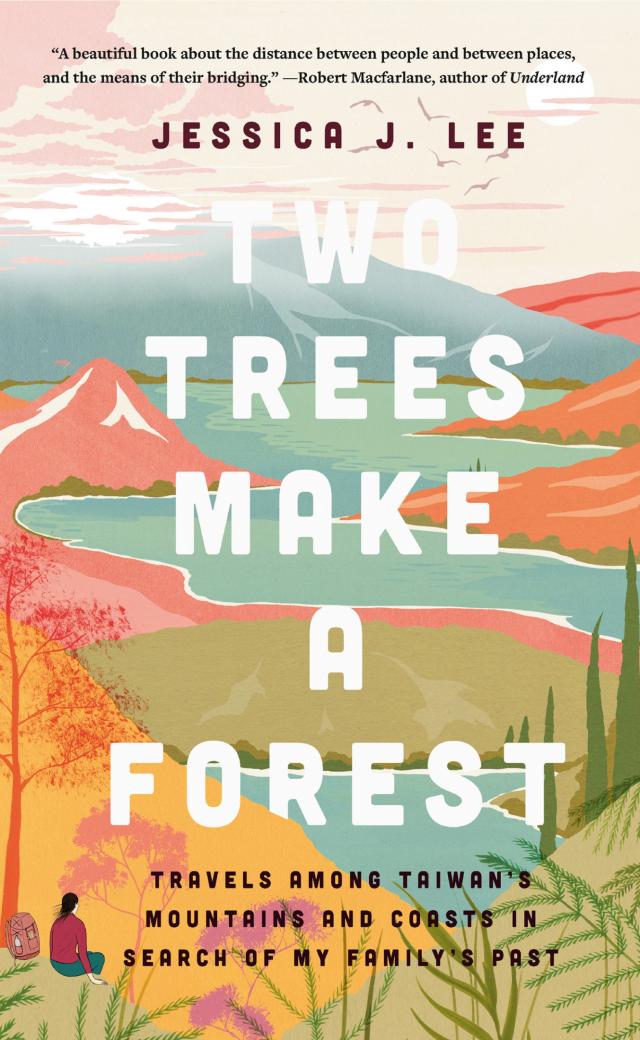
Two trees make a forest, p.1
Two Trees Make a Forest, page 1


Praise for Two Trees Make a Forest
A New Statesman Book of the Year
“Two Trees Make a Forest is a finely faceted meditation on memory, love, landscape—and finding a home in language. Its short, shining sections tilt yearningly toward one another; in form as well as content, this is a beautiful book about the distance between people and between places, and the means of their bridging.”
—ROBERT MACFARLANE, author of Underland
“Jessica J. Lee shows in this book how a delicate interrogation of language and place can be critical to understanding where we are going.”
—BONNIE TSUI, author of Why We Swim
“A subtle, powerful exploration of the relationship between people and place, and a luminous evocation of an extraordinary landscape.”
—MELISSA HARRISON, author of All Among the Barley
“Both clear-eyed and tenderhearted, Two Trees Make a Forest is a profound and gorgeously written meditation on the natural and familial environments that shape us. Jessica J. Lee is a poetic talent keenly attentive to the mysterious and sublime.”
—SHARLENE TEO, author of Ponti
“Two Trees Make a Forest takes a twisting path through mountain passes, over tree roots, by spoon-billed birds, and into a family’s past. In this thoughtful memoir, Lee asks the reader to wonder, What makes a homeland? Is it language, family, landscape? I was left with a full heart and a longing to learn the name of each tree that lines my own past.”
—ROWAN HISAYO BUCHANAN, author of Starling Days
“There is so much loss in this family story—and in many family stories—and Lee has portrayed it with detail and restraint. Lee describes the complexities and anxieties of identity and language in a way that I know will have resonance with many readers, especially those with scattered families, disparate backgrounds. A beautiful, fully realized tribute to a family, and a brave, diligent search for understanding in the mist.”
—AMY LIPTROT, author of The Outrun
“Two Trees Make a Forest is a stunning book. It is full of family, longing, ghosts, and landscapes, all of which, in Lee’s deft and beautiful telling, invoke the complications of belonging to worlds both human and natural. Lee’s writing is alive equally to the details of forests and to the daily lives of her parents and grandparents. The narrative emerges out of Taiwan’s mists layer by layer, reminding us how place, experience, memory, and the bones of the earth remake one over time. A powerful meditation on the forces that shape our lives, from bedrock to the language we use to describe it.”
—BATHSHEBA DEMUTH, author of Floating Coast
Praise for Turning
National Post (Canada), 1 of the 99 Best Books of the Year
One of Die Zeit ’s Best Books of the Year
A Notable Selection of the Sigurd F. Olson Nature Writing Awards
Long-listed for the Frank Hegyi Award for Emerging Authors
“A sublime, philosophical slipping into the deep. Her book, Turning, is filled with a wonderful melancholy as she swims through lakes laden with dark histories.”
—PHILIP HOARE, New Statesman
“A brilliant debut…There is clarity and pleasure in the swim’s afterglow.”
—HARRIET BAKER, The Times Literary Supplement
“Turning is many things: a snapshot of Berlin seen through the prism of its lakes; the story of a broken and healing heart; a contemplation of identity; a coming-of-age story.”
—KATHARINE NORBURY, The Observer
“Bold and brave, she approaches her watery pilgrimage with a minimum amount of fuss. She doesn’t, for instance, allow the ice on Brandenburg’s lakes to get in her way, but takes a hammer to it…Lee writes like a siren, her silken prose blending with softly worn scholarship to enchanting effect. I challenge anyone to write more compellingly about Slavic suffixes or the formation of ice.”
—OLIVER BALCH, Literary Review
“A lovely, poetic, sensuous and melancholy book.”
—JOSEPHINE FENTON, Irish Examiner
“The redemptive power of these wild landscapes, the changes in the water, and in Jessica, combine to create an inspiring story.”
—The Daily Telegraph
“Jessica J. Lee’s first book is lyrical and profound, told…in stunning prose and with poetic flare; it’s poignant and moving and passionate…A lexeme masterpiece…Wafting sweetly even through the weighty bits, her musings as steady and tender in sadness as learned peace. Too intimate to be comfortable, but told with a piercing vulnerability so affecting you wind up feeling close to Lee anyway, side-by-side and stroke-by-stroke, solidarity in life and lake and existential slog, 52 times over, together better for it.”
—TERRA ARNONE, National Post (Canada)
“Lee is an elegant writer; precise in her description, thoughtful in her observation, and most of all interested in the world that surrounds her…Jessica J. Lee’s is a trip to the lake well worth taking, inspiring even this reluctant swimmer to reach for his swimming shorts.”
—PAUL SCRATON, Elsewhere
“[Lee’s] beautifully written memoir combines personal memories with geographic and historical observations that should resonate even for staunch landlubbers.”
—Metro
“I loved this beautiful book. It’s an attentive meditation on the pleasures and lessons of swimming in lakes, particularly in winter. Jessica J. Lee wears her bravery lightly and shares her knowledge with generosity. I recommend for outdoor swimmers or those who would like to be.”
—AMY LIPTROT, author of The Outrun
“Jessica J. Lee is a writer of rare and exhilarating grace. In Turning, she sounds the depths of lakes and her own life, never flinching from darkness, surfacing to fresh understandings of her place in the welter of natural and human history. A beautiful, moody, bracing debut.”
—KATE HARRIS, author of Lands of Lost Borders
“A deeply moving meditation on solitude, yearning, loss, and love. This lake of a book submerged and enveloped me. It is a truly beautiful offering.”
—KYO MACLEAR, author of Birds Art Life
“Lee’s language is sharp as ice on a frozen lake. It’s astounding how, to explore her past and her own shifting identity, she uses the land as a metaphor but tempers it with a view of yearning, the sight of someone once removed who can never really go back home again. Insightful, unconventional, moving, and inspiring, I think this book will appeal to anyone who has ever struggled across the darkness trying to find the light.”
—YASUKO THANH, author of Mysterious Fragrance of the Yellow Mountains
ALSO BY JESSICA J. LEE
Turning: A Year in the Water
HAMISH HAMILTON an imprint of Penguin Canada, a division of Penguin Random House Canada Limited
Canada • USA • UK • Ireland • Australia • New Zealand • India • South Africa • China
First published in Great Britain in 2019 by Virago Press, an imprint of Little Brown Group Published in Hamish Hamilton paperback by Penguin Canada, 2020 Simultaneously published in the United States by Catapult Books
Copyright © 2020 by Jessica J. Lee
All rights reserved. Without limiting the rights under copyright reserved above, no part of this publication may be reproduced, stored in or introduced into a retrieval system, or transmitted in any form or by any means (electronic, mechanical, photocopying, recording or otherwise), without the prior written permission of both the copyright owner and the above publisher of this book.
www.penguinrandomhouse.ca
Epigraph from “The Papaya Tree” © 2017 by Brandon Shimoda reprinted with permission of the author.
Excerpt from Taiwan’s Imagined Geography: Chinese Colonial Travel Writing and Pictures, 1683–1895 by Emma Jinhua Teng. Copyright © 2004 by the President and Fellows of Harvard College. Reprinted with permission of the Harvard University Asia Center.
Excerpt from Mountains of the Mind © 2003 by Robert Macfarlane. Reproduced with permission of Granta Books.
Excerpts from Liu Ka-shiang’s “Small Is Beautiful” from The Isle Full of Noises, edited by Dominic Cheung. Copyright © 1987 by Columbia University Press. Reprinted with permission of the publisher.
Excerpt from Liu Ka-shiang’s “Black-faced Spoonbill,” Interdisciplinary Studies in Literature and Environment, 2004, vol. 11, issue 2, pp. 268–69, by permission of the Association for Literature and Environment.
Library and Archives Canada Cataloguing in Publication Data is available upon request.
ISBN 9780735239579 (softcover) | ISBN 9780735239586 (ebook)
Ebook ISBN 9780735239586
Cover illustration © Harriet Lee Merrion
Book design by Wah-Ming Chang
Calligraphy by Shih-Ming Chang
a_prh_5.5.0_c0_r0
CONTENTS
Cover
Also by Jessica J. Lee
Title Page
Copyright
Dedication
Epigraph
A Note on the Text
Timeline
Map
Dao
Chapter 1
Chapter 2
Chapter 3
Chapter 4
Shan
Chapter 5
C hapter 6
Chapter 7
Shui
Chapter 8
Chapter 9
Chapter 10
Chapter 11
Lin
Chapter 12
Chapter 13
Chapter 14
Chapter 15
Chapter 16
Acknowledgments
Bibliography
About the Author
For my family
Suddenly the tree was like the stake at the base of which the ashes of ghosts had cooled.
BRANDON SHIMODA
“The Papaya Tree”
A NOTE ON THE TEXT
LANGUAGE BARRIERS PLAY A PROMINENT ROLE in this story. Attentive readers of Chinese will note that, while I have used traditional Chinese characters, as is common in Taiwan, I’ve used a combination of the older Wade-Giles romanization system and Hanyu Pinyin (mainland Chinese) to transliterate names, places, and other details from Mandarin.
I’ve retained both forms in this book because usage in Taiwan and among those around me fluctuates—itself a lively illustration of the complexity of language in Taiwan today. Generally speaking, if I am writing about mainland China I have used Hanyu Pinyin, while for Taiwanese place-names I have mostly used Wade-Giles or occasionally the Tongyong Pinyin transliterations commonly used by local people and on signage. Google Maps—which uses Hanyu Pinyin—renders the process of moving between digital maps and local usage somewhat complicated, so for places where Hanyu Pinyin has supplanted Wade-Giles (for example, Nenggao Mountain), I have used those names. For simplicity of reading between the two styles, I have omitted tone marks from my transliterations.
It should be noted that Wade-Giles is the preferred style of my elders; Hanyu Pinyin is what I was subsequently taught.
The gaps that bind us span more than the distances between words.
In Taiwan
~9 million years ago
Formation of Taiwan begins
~6,000–10,000 years ago
Indigenous settlement of Taiwan
1542
Portuguese sailors see Taiwan and declare it “Ilha Formosa”
1624
Dutch arrival to present-day Tainan
1626
Spanish settlement in northern Taiwan
1661
Koxinga sails to Taiwan and defeats Dutch forces
1683
Qing Dynasty rule
1853
Beginning of foreign biological surveys
1895–1945
Taiwan ceded to Japan in Treaty of Shimonoseki
1945
Taiwan reverts to Chinese rule under the Nationalists
1949
End of Chinese Civil War.
Taiwan Martial Law begins
1971
Republic of China (Taiwan) removed from United Nations; the People’s Republic of China takes its seat
1987
End of Taiwan’s Martial Law Period
1999
The Chichi (Jiu’er’yi) Earthquake, September 21
2009
Typhoon Morakot strikes Taiwan
In China
1636
Beginning of Qing Dynasty
1912
End of Chinese Qing Dynasty / Founding of Republic of China
1927
Chinese Civil War begins
1937–1945
Second Sino-Japanese War (Pacific Theater of Second World War)
1966–1976
Cultural Revolution
1989
Tiananmen Square protests
DAO
n. ISLAND
Islands emerge through movement, through collision, and through accretion.
1
I HAVE LEARNED MANY WORDS FOR “ISLAND”: isle, atoll, eyot, skerry. They exist in archipelagos or alone, and I have always understood them by their relation to water. The English word “island,” after all, comes from the German “aue,” from the Latin “aqua,” meaning “water.” An island is a world afloat; an archipelago is a place pelagic.
The Chinese word for island knows nothing of water. For a civilization grown inland from the sea, the vastness of mountains was a better metaphor: 島 dao (“island,” pronounced “to” in Taiwanese) is built from the relationship between earth and sky. The character contains the idea that a bird 鳥 (niao) can rest on a lone mountain 山 (shan).
Taiwan is just eighty-nine miles wide, but in that distance it climbs nearly thirteen thousand feet from sea level. The jump to precipitous peaks creates a wealth of habitats, such that the island sustains a range of forests much vaster than its small footprint. The coasts are muffled with salt- and sun-soaked mangroves, and moving south, thick tropical jungle grows. The wet heat of a tropical rain forest thrums to temperate trees, and their hardwoods climb to pines. Boreal forests—with towering, size-of-a-house cathedral trees—grow up from the middle slopes of the island. Beyond the tree line, the mountains peter out to prairie, cane grasslands widening toward an alpine sky. Like topographical rings on a map, the trees array themselves by elevation.
Born into conflict at the junction of two volcanic arcs, Taiwan is an unstable landmass in perpetual confrontation. Set along the Ring of Fire—the Pacific zone plagued by quakes and eruptions—southeast of China, west of Japan, north of the Philippines, the island marks the border of two tectonic plates: this is known to geologists as a destructive plate boundary. The collision of the Eurasian and Philippine Sea plates forced the island into being some 6 to 9 million years ago, during the Miocene epoch. Such collisions are powerful, with one plate thrust beneath another, raising land from the sea and into the air. But these borders can be devastating, too.
The Central Mountain Range, running some 170 miles, four-fifths of the island’s length, and the Hsuehshan Range, arcing halfway across the island’s north, are flanked on either side by faults. The foothills and flatlands to the west wear breakage like errant stitching on a quilt, determining and dividing the landscape. To the east, the Coastal Mountain Range is pressed between fault lines and the sea.
More than two hundred of the island’s peaks are higher than three thousand meters, monuments to tectonic change set fast into schist, gneiss, marble, and slate. The mountains are among the youngest in the world, and they continue to shift as the Philippine Sea Plate moves westward at around eighty millimeters a year. Through the forces of orogeny that form great mountain chains, Taiwan’s peaks stand taller every day.
Islands transfix us, their mythologies tied as much to their isolation as to imagination. Long-sought Ithaca or the seaport in a tempest, the islands I know from stories can be both real and fanciful; material places of rock and soil, they come laden with the ideological weight of Edens and arcadias, with visions of paradise.
The Chinese coastline is littered with islands close at hand—easy to reach, knowable—but for centuries, those in the distance across the Taiwan Strait or the East China Sea remained treacherous to reach and explore. It is easy to imagine how they might have been idealized, or likewise abhorred, for their distance from Chinese civilization. In Chinese myth, Penglai—described as both a mountain and an island—was the home of the immortals, blessed with cups that never ran dry, with rice bowls that never emptied. In the third century B.C., the first emperor of a unified China sought the mythic island, sailing his ships to the east. It is said that the emperor’s emissaries found Japan instead.
But Penglai—蓬萊—is also one of the traditional names for Taiwan. It was for this wealth of natural resources that Qing explorers first ventured to the island that was renowned for its abundance. In 1697, the colonial scribe Yu Yonghe traveled in search of sulfur. In his journey along the coast, led by indigenous guides and servants, he described rice grains the size of beans and island crops providing perhaps twice the harvest of the mainland. Coconuts could be split and used as cups for wine. He wrote that Taiwan’s fruit—plentiful but mostly unfamiliar to the voyagers—would spoil on the journey back to the mainland; the island was vital and abundant but entirely unto itself. For those from the continent, these eastern archipelagos were brimming with life, mountains in a turbulent sea. But unlike the immortal islands of myth, Taiwan belonged to the material realm, a living world on a fault-ridden terrain.