

Boundless, p.1
Boundless, page 1
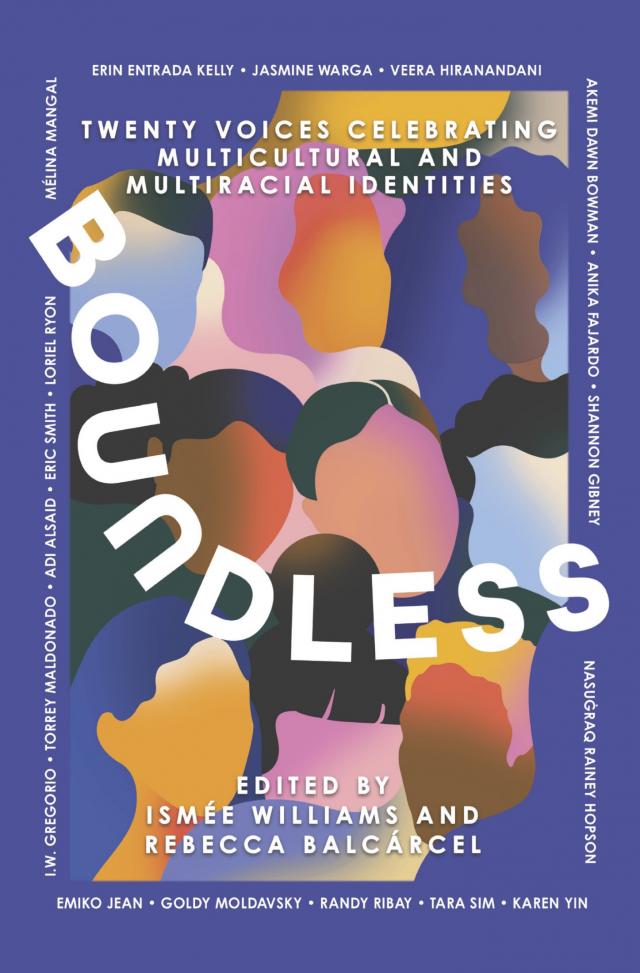


BOUNDLESS
Edited by
Ismée Williams and Rebecca Balcárcel
Contributors:
Adi Alsaid
Akemi Dawn Bowman
Anika Fajardo
Shannon Gibney
I.W. Gregorio
Veera Hiranandani
Nasuġraq Rainey Hopson
Emiko Jean
Erin Entrada Kelly
Torrey Maldonado
Mélina Mangal
Goldy Moldavsky
Randy Ribay
Loriel Ryon
Tara Sim
Eric Smith
Jasmine Warga
Karen Yin
To all whose identities cross boundaries
And to love that knows no bounds
Contents
A FOREWORD FROM THE EDITORS
THE CHAIR FAR AWAY FROM THE TABLE by Akemi Dawn Bowman
HISPANIC JEWISH BINGO by Goldy Moldavsky
THE PERILS OF BEIGE by Nasuġraq Rainey Hopson
INVISIBLE by Emiko Jean
MARIACHIS VS. BLUEGRASS by Loriel Ryon
I AM NOT A PAPAYA by Veera Hiranandani
BETWEEN VISIBILITIES by Adi Alsaid
ENOUGH TO BE A REAL THING by I.W. Gregorio
THICKER THAN WATER by Ismée Williams
MY KINDA SORTA BADASS MOVE by Karen Yin
I LIKE TO BE IN AMERICA by Anika Fajardo
MICHELLE AND YVETTE IN KAISERSLAUTERN by Mélina Mangal
IRISH SODA BREAD by Eric Smith
THE MORTIFICATION by Shannon Gibney
BETWEEN LAYERS by Tara Sim
DIFFERENT by Torrey Maldonado
CONFESSION by Erin Entrada Kelly
A HALFIE’S GUIDE TO MEXICAN RESTAURANTS by Rebecca Balcárcel
EFFING NICO by Randy Ribay
SEARCHING by Jasmine Warga
ABOUT THE EDITORS
ABOUT THE AUTHORS
A FOREWORD FROM THE EDITORS
We all struggle to figure out who we are and where we belong. We try to find our place and our people. It’s a lot harder if we don’t even fit in with our own family. Some of us don’t have the skin color of either of our parents; some of us don’t speak the languages of our grandparents; some of us have siblings who look like one race while we look like another. Meanwhile, outsiders puzzle over which box to put us in.
The authors in this anthology are all multiracial and/or multicultural. We have all faced challenges with our identity. At times, we have felt alone and without connection to either of our parents’ communities, like islands set apart. However, because we have lived in two or more cultures, we also have developed extraordinary empathy and resilience. We recognize multiple ways of living, multiple lenses on the world, and various sides of conversations because we live, speak, and breathe these different sides. We can bring together distinct groups, improving communication and understanding between them. We can be bridges.
When we look in the mirror, in our pantries, in our hearts, or in the eyes of someone who says, “What are you?” we know we don’t fit into one category. At times, this is awkward, even painful. But we hope readers will see what it means to transcend categories, to be uncontained by a checkmark in a single box, to be boundless.
Our stories are nuanced and as varied as our own experiences. We hope you enjoy them.
THE CHAIR FAR AWAY FROM THE TABLE
By Akemi Dawn Bowman
SPRING
When Aunty Fei opens the door, the smell of chicken katsu, barbecued ribs, and potato curry tumbles out of the house like an explosion of contradiction—sweet and spicy, old and new, Asian and not Asian.
Well, maybe the last part is just me. Projecting, as Hannah says.
My older sister beams beside me and holds up a paper bag. “We brought sweet rolls!”
“I told you on the phone not to bring anything but yourselves,” Aunty Fei scolds, even though her eyes are sparkling. She glances at Dad, who inhales the intoxicating scents from the doorway. “Save your money, Hiroichi. We have enough food to feed an army.”
Dad laughs. “I’ll remember that for next time.”
He says that every week, but we never show up to karaoke night empty-handed. Aunty Fei may pretend like it’s not necessary, but it’s one of the unspoken rules Dad’s side of the family seems to have. You’re supposed to make an effort, even when everyone tells you not to.
Aunty Fei waves us all in. “I hope you folks are hungry.”
“Starving,” Dad replies, and Hannah and I follow him inside.
There’s a row of aunties already waiting to greet us. They make all their usual comments—they ask how we’ve been managing since Mom left, they ask Hannah what she’s planning to study at college, and they tell me I’m getting “so tall, just like your dad,” even though me and Dad aren’t exactly being recruited for a basketball team anytime soon.
And then they shuffle us toward the enormous table packed to the edges with Crock-Pots, glass bowls, and ceramic dishes. All the usual potluck favorites are here, plus a few new ones from the extended aunties and uncles.
Technically they’re not all relatives, but my family is from Hawaii. Every friend of the family is considered an aunty, uncle, or cousin.
Someone shoves a plate in my hand, and Hannah nudges me forward, hurrying to get to the dish wedged between the potato mac salad and the spam musubi.
“They have the Jell-O,” she whispers over my shoulder.
It’s the most out of place dish on the whole buffet table. Half emerald-green, half milky-white, Aunty Fei has been making the half-and-half Jell-O squares for as long as I can remember.
I put two pieces on my plate and surround them with rice and chicken skewers.
One of the aunties sees my choices and looks personally offended, but then brightens when she sees everything on Hannah’s plate.
Hannah tries everything—even the smoked tako—and everyone in the family seems to love her for it.
I don’t have my sister’s people skills, or her palate for octopus. I don’t even have her features, which are unmistakably similar to Dad’s.
She never wonders if she’s Asian enough to be a part of this family. But me?
I’m more like the puzzle piece that accidentally ended up in the wrong box. I don’t fit.
Hannah disappears with everyone else into the dining room where the Big Table is set up for all the grown-ups. My sister is only just eighteen, but she stopped sitting at the kids’ table years ago.
I’m not sure if I was ready for her to leave me behind, but Mom used to come to karaoke nights back then, and she never sat at the Big Table. She said she preferred sitting with the kids.
Maybe she never felt like she fit in, either.
But Mom is on the other side of the country now, chasing dreams that were too big to find in Las Vegas. And I’m too old for the kids’ table.
I take my plate and find a spot in the corner of the living room, where Uncle Albert is sitting in his favorite red chair. I plop down a few feet away, eating in awkward silence while Uncle Albert rests his eyes.
He doesn’t like socializing with the other aunties and uncles. I’m not sure he likes people coming to the house at all.
But I’ve been gravitating toward Uncle Albert and his chair ever since I was little, and he never tells me to leave. He just lets me sit with him in the quiet, and occasionally offers me candy.
Out of everyone in my family, I think I relate to him the most.
After dinner, my relatives flock to the TV in the big living room, where me and Uncle Albert are still sitting in the corner. There are over a dozen aunties and uncles, all gathered on footstools, cushions, armchairs, and patches of carpet.
When the blue karaoke image appears on the screen, one of my oldest uncles moves for the microphone and bursts into a very animated rendition of “Nagasaki Wa Kyou Mo Ame Datta.”
And then Hannah leaps to her feet, rushing for the next turn while everyone offers words of encouragement.
Hannah doesn’t even speak Japanese, but she knows all these old songs by heart. She’s been singing them since Aunty Fei started karaoke nights.
I watch from the back of the room, like I’m on the outside looking in.
It’s easy for Hannah. She looks more the part than I do; she has Dad’s black hair and dark eyes, and skin that tans impeccably well in the sun. I inherited Mom’s freckles and mousy brown hair and a face that is neither Asian nor white. It’s racially ambiguous. The kind of face that confuses people, and they end up asking the same question over and over again. The question I dread most.
What are you?
Nobody on my dad’s side of the family ever asks me that. But sometimes they look at me like they’re waiting for me to figure it out.
Uncle Albert leans forward and grunts, interrupting my thoughts. He’s holding a koa box full of See’s lollipops: chocolate, coffee, vanilla, and butterscotch.
I take one of the butterscotch ones because they’re my favorite, and pull off the wrapper. “Thanks,” I mumble.
Uncle Albert twists his mouth and sinks back into his chair, setting the box beside him while Hannah finishes singing the last note in her song.
Aunty Fei’s gaze immediately seeks me out like a spotlight. “Come, Nina,” she calls
I shake my head and point to the candy in my mouth like I’m apologizing, even though singing in front of my relatives—in front of anyone—is a genuine, recurring nightmare. I think I might even prefer the smoked tako.
Hannah stares at me for a second too long before handing the mic to one of our cousins. She takes a seat next to Dad, but she’s still watching me with the kind of urgency that makes me nervous and embarrassed all at once.
We’ve never had a secret sister language. We’re not even really close.
But ever since Mom left, Hannah has been acting weird. Like she thinks she needs to fix me before she leaves for college and she’s out of time.
I tug at my sleeve, cheeks burning when Hannah shakes her head at me from across the room. She doesn’t have to say anything—I can read the message in her eyes.
You have to try, Nina.
Not about karaoke—she wants me to try harder to be a part of this family.
But she doesn’t get it. Belonging comes naturally to her. She’s never had to try.
I wish being myself were already enough.
I stare at the carpet, thinking of Mom on the other side of the country, and wonder why loving me wasn’t enough to make her stay.
SUMMER
I sit in the living room, wedged between the floor fan and Uncle Albert. I forgot to bring a scrunchie, so I grab my hair with a fist and hold it off my neck.
Uncle Albert’s snores grow and grow until he startles himself awake. He jolts, searching the room for all its familiarities, and then drifts back into a nap.
Hannah appears with her hands on her hips. “The buffet is outside,” she says, using that weird Mom-like voice that’s only gotten more obnoxious over the months. “Aren’t you coming?”
“It’s July,” I reply with a blank face. “In Las Vegas.”
She lifts her shoulders like she doesn’t understand my point.
“It’s like a hundred and twenty degrees.”
“So? They have misters. Just put on some sunscreen—you’ll be fine.”
“I’m fine in here.”
“Seriously, Nina,” Hannah says, and now her arms are crossed, so I guess she’s really upping the Mom impersonation. “You can’t just keep avoiding everyone all the time. You need to be around other people.”
I twist my mouth. “Nobody needs to be around other people.”
“Yes they do,” she snaps back. “Social isolation is literally a form of torture. You’re just weird.”
Her last word stings like salt in a wound that won’t heal.
Hannah purses her lips. “I know Mom is gone, but—”
“This isn’t about Mom,” I say, bristling. Even though I mean it, Mom is always going to be a sore subject. It doesn’t matter that she left months ago; there isn’t a time limit on when I should be okay with one of our parents abandoning us.
I will never be okay with it.
Hannah sighs like she’s tired, and maybe she is. But maybe I am, too. “She hated karaoke nights. And I think she made you hate them.”
“She didn’t make me do anything.”
“Really? Because you were basically her shadow for fifteen years, Nina. You never left her side. You would’ve done anything to make her happy, even when she constantly asked for too much.”
A scowl tears across my face. “What’s that supposed to mean?”
Hannah’s hands shoot up in desperation. “You didn’t even yell at her when she left! She told you to understand, and you just...did. And now she’s gone and it’s like you’re this lost puppy. I’m worried.”
I flatten my mouth, holding back the words I want to say but wouldn’t dare in front of Uncle Albert, sleeping or otherwise.
It was always me and Mom on one side, and Hannah and Dad on the other. Two different sides of a coin. Two contradictions.
Mom didn’t abandon them the same way she abandoned me. She left them—but she left me behind.
I wasn’t supposed to have to be a teenager without her. I wasn’t supposed to feel this alone.
Of course I’m angry. Of course I’m sad. But what good would it do to say it out loud?
Nobody here would understand.
I don’t want my mom to be the villain. But she was the person who felt most like family, and she didn’t choose me.
“I’m not talking about this with you.” My voice is stiff, and maybe a little cold.
But Hannah pushes anyway. “Family is important. Please try to make an effort. For Dad.”
“What does Dad have to do with this?”
She eyes Uncle Albert, still asleep in his chair. “I think he needs karaoke nights more than you realize,” Hannah says solemnly. “And I think... I think it’s good for him to have a reason to leave the house. I think it’s good for both of you.”
“If you’re worried about Dad, fine,” I reply sourly. “But leave me out of it.”
Hannah sighs. In a voice that’s barely audible, she adds, “I just don’t want you to always feel disconnected from the people who care about you. Mom liked to make her problems your problems. If she couldn’t fit in, she didn’t want you to, either. She didn’t want to be alone—but she had no problem leaving us alone.” She shakes her head. “You always deserved more than being Mom’s shadow. You can just be you. I hope someday you’ll believe it.”
My mind spins too fast to reply, and then Hannah is gone and it’s just me, Uncle Albert, and the buzzing fan.
When he speaks, his voice croaks like a bullfrog. “You’re angry at the wrong person. Your sister is just trying to help.”
I sit up, slightly alarmed. “I—I thought you were asleep.”
“You woke me up.”
My cheeks flush. “Sorry.”
Uncle Albert folds his hands over his stomach. “How come you’re always sitting here instead of hanging out with everybody else?”
“It’s not like anyone cares.” When I hear the words out loud, my eyes open wide. “I don’t mean it in a bad way—I just mean that I’m not good at being around people the way Hannah is. So it doesn’t really matter if I’m here or outside, you know? I’m like...invisible, I guess.”
“Why do you have to be like your sister to spend time with your family?”
I blink. “Hannah is likable. She fits in. She sings karaoke and eats all the spicy food. She knows what to say to make everyone smile.”
“You think eating spicy food gives you permission to sit at the table with everybody else?”
My jaw tenses, but I don’t respond. I don’t really know how to. Maybe it sounds silly, but Hannah never questions whether she belongs. She just does.
I guess I’m still trying to figure out what the difference between us is.
Uncle Albert stares up at the ceiling like he’s searching for a memory. And then he lifts the koa box from the side table, removes the lid, and holds it toward me.
I take a butterscotch lollipop. He takes a coffee one.
We sit in the silence for a long, long time, listening to laughter in the distance. And I think maybe Uncle Albert understands me more than he wants to admit.
Maybe deep down, he doesn’t feel like he belongs, either.
FALL
It’s strange not seeing Hannah at karaoke nights. She still calls once a week to catch up with Dad and tell him about college. But there’s an empty space she left behind that’s even more noticeable than the one Mom left. She was a constant in our family—like the North Star. A nearly ever fixed source of light that everyone was drawn to. Dad most of all.
All Dad and I really share is the quiet.
And sometimes the quiet is the loudest thing of all.
I sit in the corner of the living room with my head down, drawing shapes in the carpet.
When the koa box appears in front of me, I take a piece of candy and look up at Uncle Albert. His brown eyes are thoughtful, watching me with a calm recognition.
He doesn’t take the box away. “Give one to your dad,” he says curtly. “He used to like the butterscotch ones when he was little, too.”
I hold it in my hand, rolling the lollipop stick between my fingers. “I know what you’re trying to do.”






