

Argylle, p.1
Argylle, page 1


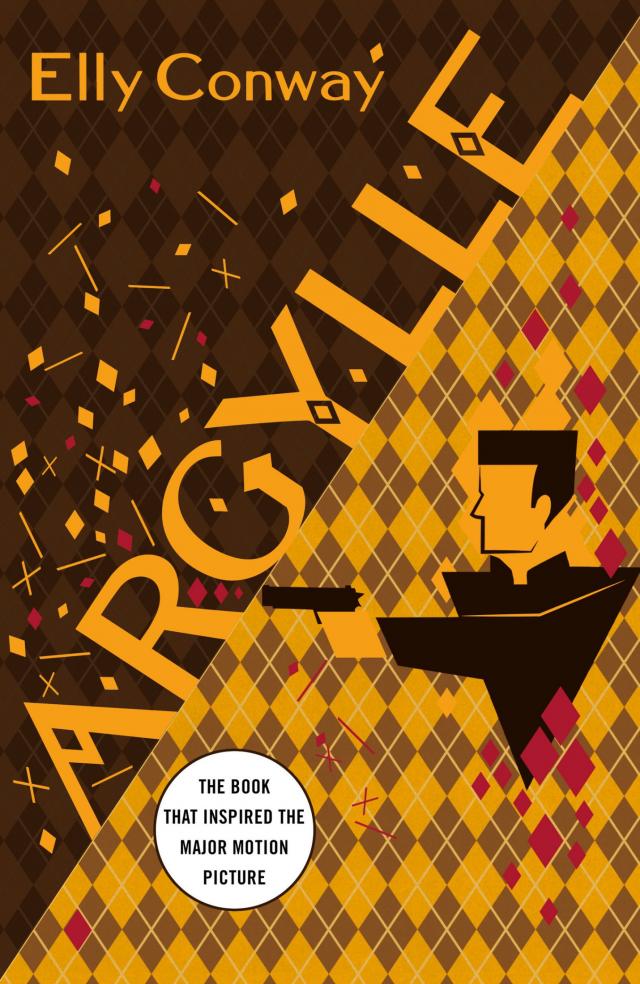
Argylle is a work of fiction. Names, characters, places, and incidents are the products of the author’s imagination or are used fictitiously. Any resemblance to actual events, locales, or persons, living or dead, is entirely coincidental.
Copyright © 2024 by Marv Quinn Holdings Limited
All rights reserved.
Published in the United States by Bantam Books, an imprint of Random House, a division of Penguin Random House LLC, New York.
Bantam & B colophon is a registered trademark of Penguin Random House LLC.
Published in Great Britain in 2024 by Bantam Press, an imprint of Transworld Publishers.
Hardback ISBN 9780593600016
Ebook ISBN 9780593600023
randomhousebooks.com
Cover design by MinaLima
ep_prh_6.2_145852933_c0_r1
Contents
Cover
Title Page
Copyright
Epigraph
Author’s Note for New Edition
Prologue
Part One
Chapter 1
Chapter 2
Chapter 3
Chapter 4
Chapter 5
Chapter 6
Chapter 7
Chapter 8
Chapter 9
Chapter 10
Chapter 11
Chapter 12
Chapter 13
Chapter 14
Chapter 15
Chapter 16
Chapter 17
Part Two
Chapter 18
Chapter 19
Chapter 20
Chapter 21
Chapter 22
Chapter 23
Chapter 24
Chapter 25
Chapter 26
Chapter 27
Chapter 28
Chapter 29
Chapter 30
Chapter 31
Chapter 32
Chapter 33
Chapter 34
Chapter 35
Chapter 36
Chapter 37
Chapter 38
Chapter 39
Chapter 40
Chapter 41
Chapter 42
Chapter 43
Chapter 44
Chapter 45
Chapter 46
Part Three
Chapter 47
Chapter 48
Chapter 49
Chapter 50
Chapter 51
Chapter 52
Chapter 53
Chapter 54
Chapter 55
Chapter 56
Chapter 57
Chapter 58
Epilogue
Dedication
Author Apology and Acknowledgements
About the Author
_145852933_
‘Sometimes it is necessary to be lonely in order to prove that you are right.’
– attributed to Vladimir Putin
‘The women laughed and wept; the crowd stamped their feet enthusiastically, for at that moment Quasimodo was really beautiful. He was handsome – this orphan, this foundling, this outcast.’
– Victor Hugo, The Hunchback of Notre-Dame
‘The Amber Room represents to Russians many of the things we have lost.’
– Ivan Sautov, director of the Catherine Palace museum
(quoted in Forbes Life magazine, ‘Mysteries of the Amber Room’, 29 March 2004)
Author’s Note for New Edition
Note too long ago, I suffered a terrible accident that completely shattered my life. While I was recuperating and feeling sorry for myself, my parents would bring me movies and books to try to ignite my interest in something – anything – that wasn’t about me and this terrible thing that had happened to me. One particular morning, my mother turned up with a book of photographs of beautiful landscapes. One of them was of a mountain range in southern Poland. It meant nothing to me, but as I looked at it I felt a tug of something and, that night, Aubrey Argylle came to me, fully formed, in a febrile dream, with his Nehru jacket and flat-top hair and buried sadnesses and his need to put right what the world keeps getting wrong. When I woke up he was in my head as if he’d walked right in the door and kicked off his shoes and made himself at home. I know writers roll their eyes when other writers say, ‘The book wrote itself,’ but this one really did (please don’t hate me, guys). And in writing it, I gained a new purpose, and from that point on I began to heal. So I need to say thank you: to whoever took that photograph, to my parents, and most of all to Aubrey Argylle for bringing me back to myself and reminding me that sometimes the tools we need to fix ourselves are inside us the whole time.
Elly Conway, 2023
Prologue
There are few places on earth more desolate than south-eastern Siberia at dawn on a bitingly cold March morning. The spiky pine forests of the taiga carpet the ground like a bed of green nails. Here there is no birdsong to pierce the minus-twenty-five-degree air. Only the whip of the wind and the plaintive howl of a distant wolf.
But a sound breaks the dead silence, a soft rumble growing louder, and now something appears, glinting in the early-morning sun. A high-speed train, its pointed nose spearing a path through the freezing air, plunging relentlessly onwards, as the thick forest gives way to swampy lowlands and windswept tundra.
In the standard carriages people lie on narrow berths, their faces to the wall, sleeping off last night’s vodka, or else sit huddled on the bottom bunks eating pirozhki, watching the scenery through smeared and grimy windows. But at the rear of the silver streak there is something quite different. A carriage of gold, bearing the initials V F and I F intertwined in imperial purple.
The real-life VF and IF – otherwise known as Vasily and Irina Federov – are very much not intertwined. In fact, it would be hard to imagine two people sharing so confined a space in a more separate manner. Irina sits in a high-backed armchair which is really more of a throne than a chair, her left foot soaking in a porcelain bowl full of rose oil with petals floating on the surface, while a pinafore-clad woman kneels on the floor vigorously scrubbing the sole of her right foot with seaweed picked up fresh from the port in Vladivostok before the train departed.
Irina has a magazine in her hands, through which she flicks uninterestedly. The train will take six more days to arrive in Moscow and cellphone coverage is practically non-existent, for all that ‘cutting-edge technology’ they were promised. She cannot talk to her friends or her sister. Cannot complain to them that being trapped in this gilded carriage with her husband makes her want to claw off her own skin. Cannot tell them how his soft voice grates at her nerve endings and that when he fixes her with his colourless, lifeless eyes behind those rimless glasses she feels like a butterfly on a pin.
And even if she could talk to them, what would they say? That they had warned her against marrying an outsider, when she could have had her pick from the old Russian families. Generations as easily traceable as the veins on your wrist. That having made her misguided choice, she should console herself by spending his billions. A holiday home on Lake Valdai. An apartment in Knightsbridge. A villa on the French Riviera. Lavish furnishings. A new yacht. More liposuction. Longer hair extensions. By now she has had so many surgeries that when she stands in front of the mirror she doesn’t recognize her own face. ‘Careful,’ he’d said the last time she came back from that private hospital in Beverly Hills, standing behind her at her dressing table as he pulled the still-tender skin on her cheeks back towards her hairline. ‘If you stretch it any more, it will tear like an old paper bag.’
The beautician, who is now using a pumice stone on the tougher skin of her heel, presses too hard. ‘Watch what you’re doing!’ Irina kicks out, unbalancing the woman, who puts out a hand to stop herself, nudging the porcelain tub and sending a small surge of water on to the plush carpet. ‘Idiot!’
Across the carriage, almost as far as it is possible to be, Irina’s husband looks up. But if he is angry at the disturbance, or concerned, or just curious even, it does not show in his flat, unremarkably featured face. He is sitting by the window in a matching armchair to his wife’s, a polished wood desk in front of him, on which sits a laptop computer the size of a small briefcase. He is looking over his notes for the live televised debate he will take part in when he arrives in Moscow. They could have flown in, of course, on one of his two private jets, but it is all part of the campaign, this magisterial process through the parts of Russia most politicians ignore – sending a message to the dispossessed hordes in the rural backwaters that they have not been forgotten, not by him anyway, gathering up the populist vote one disaffected peasant at a time.
At first he had wavered about the golden coach. The last two winters have been hard here. People are hungry. ‘I don’t want to be accused of flaunting my wealth,’ he had told his chief of staff.
The man had raised his eyebrows. ‘With all respect, you are coming to power on a commoner’s ticket,’ he had said, ‘the man who came from nothing to conquer the world. The people need you to embody everything they don’t have. Why would they want to be represented by a man who has nothing they aspire to, by a man who is still just like them?’
Vasily Federov has gone to great lengths to prove his Russian credentials. He has invested hundreds of millions in technological infrastructure and national causes, has bought himself a mayorship and set about ruthlessly, systematically, cleaning up the streets of the city he ruled over with the aid of his own highly trained private militia. He has married the president’s daughter, has steeped himself in Russian culture – bankrolling movies and plays and dance troupes that send him into paroxysms of boredom if he has to watch them for more than a minute at a time. Has endured hour after hour of language lessons so that he now speaks fluent Russian with only the faintest of accents. Yet still there are issues, like the golden carriage, that bring back to him the fact that he is still an outsider, remind him that he has yet to leave Christopher Clay completely behind.
The train is speeding through time zones – eight by the time they arrive at their destination. They have long passed Lake Baikal – the largest, deepest freshwater lake in the world – and Gulag Perm-36, the labour camp where so many dissidents had been held over the years. Federov has little sympathy. The Russian foundling who was unhappily adopted by Americans and grew up in the Midwest feeling like an outsider, an oddity, yearning always for his mother country, or perhaps just for his mother, he has no time for those who criticize and destabilize.
The train stops at various stations, and at each of them, in addition to the street hawkers and the travellers waiting to board, there is also a knot of people standing in the cold, the women with trousers under dresses under jumpers under coats, the men with red-raw cheeks where the wind has flayed them. They are waiting for him. Waiting for a glimpse of the golden carriage, and the man who rides inside it. The one who has promised them change. The self-made billionaire who started with nothing, with less than nothing, and made his fortune in America but will spend it right here. Not just in the cities where the oligarchs have their palaces, but in the bleak industrial towns and the neglected rural villages. The man who is saying what they want to hear – that mass immigration is a drain on resources and a dilution of Russia’s national identity, that the metropolitan centres are sucking the country dry, leaving nothing for everyone else. That the Soviet Union can be rebuilt, stronger, reabsorbing all the people whose hearts are still Russian even though they might be forced to live under an Estonian or Ukrainian flag.
But there is always that question mark, isn’t there? The accent he tries so hard to disguise. His soft hands and clean nails. His suit. His rimless glasses. He does not fit into the political narrative here. He does not come from old money and did not rise through the ranks of the Russian military. That’s why they are here to see for themselves.
So at every station he must present himself in the doorway of the train, and Irina must put on her dark glasses and her small smile that is like a paper cut in her smooth face. And they must wave. And sometimes he throws out small gifts to the crowd – pencils with his name embossed in gold on the side, sweets for the children.
Now they are through the Urals and passing Yekaterinburg, where Tsar Nicholas II and his family were killed. Again Federov spares no sympathy. Everything has its day. As they get closer to Moscow, the scenery through the window becomes more industrial – belching factories and monstrous trucks, grey towns ringed by housing blocks.
Irina sits herself down at her dressing table and reapplies her make-up with a fat, soft brush.
‘Remember to wear the bracelet,’ Federov reminds her.
It is the first time he has spoken to her all day. She makes a face, though her reflection in the mirror hardly moves, thanks to the Botox injections her private physician gives her every three months.
The bracelet both enthrals and repels her, though she knows it’s worth millions. It is made from heavy gold, crusted with diamonds, apart from one flat section which is engraved with random dots and squiggles that make no sense to her. ‘It’s called the Bracelet of Fidelity,’ her husband had told her when he gave it to her, and as he fastened the clasp around her wrist it felt like a handcuff. She’d been appalled to find the initials NC engraved on the inside. Second-hand is anathema to her, the idea of wearing something that has rested on someone else’s skin. But Federov is insistent, in that way of his. He doesn’t raise his voice, but still her flesh rises up in tiny, frozen bumps.
She puts on the bracelet.
Irina is the daughter of a president, has grown up practically as royalty in a house where, as soon as you pick up your glass, someone darts in to wipe the table before you’ve had a chance to put it down again. She alone chose this man, Vasily Federov or Christopher Clay, so she can never admit that her soft-spoken, soft-palmed husband terrifies her. There is a black hole at the centre of him and she has no idea how deep it goes.
‘Has he ever laid a hand on you?’ her sister asked once, noticing how she flinched whenever he came near. And when Irina shook her head, she’d said, ‘Probably because he is afraid of our father.’ ‘No,’ Irina had corrected her. ‘Because he can’t bear to touch me.’
Approaching the capital, Federov puts away his portable computer and goes to stand by his case, which is open on the bed. She sees his hands, with those clean, perfectly shaped nails, reach into the pocket at the side and knows what he will be looking for. It disgusts her, this obsession of his. She has known men who have fetishes for feet, for bondage, for unspeakable sexual practices. But this thing of her husband’s makes her skin crawl. The scrap of fabric that was once blue but now is grey and greasy with age and handling. His one link to the mother who rejected him not only at birth, when she left him in a phone box wrapped in the blanket of which this miserable scrap is all that remains, but again when, as a young all-American man still believing in happy endings, he flew to Russia and tracked her down to a tower block on the outskirts of Novosibirsk in the south-west of Siberia, only to have her slam the door in his face. After that he’d been half expecting the rejection from his former KGB officer father, but still the shock of it had eaten through the tender marrow of him like a cancer, cauterizing his emotions.
All this he told her at the beginning of their marriage, when there was still some softness between the two of them. Before confidences became weapons they could use against one another. Irina should have listened to her father. Birth is important. The purity of the blood that flows through your veins matters. Vasily Federov may be on the verge of becoming the most powerful man in the country. He may, as The New York Times commented last week, be the greatest threat to current world security, but deep down he will always be damaged.
* * *
—
There is a reception party waiting to greet them on the platform at Moscow’s Yaroslavsky station. Not Irina’s father, Vladimir Sokolov, but leaders of national far-right movements, including Russian National Unity and the Movement Against Illegal Immigration. Federov is gratified to notice also prominent figures from Austria’s Freedom Party and from Italy’s Lega Nord, even Vlaams Blok from Belgium.






