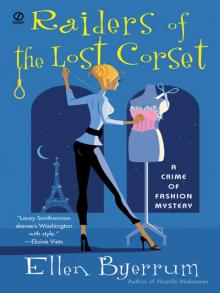
Grave apparel, p.1
Grave Apparel, page 1


Grave
Apparel
A C R I M E O F F A S H I O N M Y S T E R Y
Ellen Byerrum
A S I G N E T B O O K
Praise for the Crime of Fashion mysteries
“Lacey Smithsonian skewers Washington with style.”
—Elaine Viets, national bestselling author of
Murder with Reservations
“Devilishly funny . . . Lacey is intelligent, insightful and spunky. . . . Thoroughly likable. — The Sun (Bremerton, WA)
“Byerrum spins a mystery out of (very luxurious) whole cloth with the best of them. . . .”
—Chick Lit Books
“Fun and witty . . . with a great female sleuth.”
—Fresh Fiction
“[A] very entertaining series.”
—The Romance Reader’s Connection
Raiders of the Lost Corset
“A hilarious crime caper . . . readers will find themselves laughing out loud. . . . Ellen Byerrum has a hit series on her hands with her latest tale.”
—The Best Reviews
“I love this series. Lacey is such a wonderful character. . . . The plot has many twists and turns to keep you turning the pages to discover the truth. I highly recommend this book and series.”
—Spinetingler Magazine
“Wow. A simplistic word, but one that describes this book perfectly. I loved it! I could not put it down! . . . Lacey is a scream, and she’s not nearly as wild and funny as some of her friends. The story line twists and turns, sending the reader from Washington, DC, to France, and finally to New Orleans. . . . I loved everything about the book from the characters to the plot to the fast-paced and witty writing.”
—Roundtable Reviews
“Lacey is back, and in fine form. . . . This is probably the most complex, most serious case that Lacey has taken on, but with her upbeat attitude and fine-tuned fashion sense, there’s no one better suited to the task. Traveling with Lacey is both entertaining and dicey, but you’ll be glad you made the trip.”
—The Romance Reader’s Connection
continued . . .
Hostile Makeover
“Byerrum pulls another superlative Crime of Fashion out of her vintage cloche. . . . All these wonderful characters combine with Byerrum’s . . . clever plotting and snappy dialogue to fashion a . . . keep-’em-guessing-’til-the-end whodunit.”
—Chick Lit Books
“So much fun.”
—The Romance Reader’s Connection
“The read is as smooth as fine-grade cashmere.”
— Publishers Weekly
“Totally delightful . . . a fun and witty read.” —Fresh Fiction
Designer Knockoff
“Byerrum intersperses the book with witty excerpts from Lacey’s ‘Fashion Bites’ columns, such as ‘When Bad Clothes Happen to Good People’ and ‘Thank Heavens It’s Not Code Taupe.’ . . . Quirky . . . interesting plot twists.”
— The Sun (Bremerton, WA)
“Clever wordplay, snappy patter, and intriguing clues make this politics-meets-high-fashion whodunit a cut above the ordinary.”
— Romantic Times
“Compelling. . . . Lacey is a spunky heroine and is very self-assured as she carries off her vintage looks with much aplomb.”
—The Mystery Reader
“A very talented writer with an offbeat sense of humor and talent for creating quirky and eccentric characters that will have readers laughing at their antics.”
—The Best Reviews
Killer Hair
“[A] rippling debut. Peppered with girlfriends you’d love to have, smoldering romance you can’t resist, and Beltway insider insights you’ve got to read, Killer Hair adds a crazy twist to the concept of ‘capital murder.’ ”
—Sarah Strohmeyer, Agatha Award–winning
author of The Cinderella Pact
“Ellen Byerrum tailors her debut mystery with a sharp murder plot, entertaining fashion commentary, and gutsy characters.”
—Nancy J. Cohen, author of the
Bad Hair Day Mysteries
“Chock full of colorful, often hilarious characters. . . . Lacey herself has a delightfully catty wit. . . . A load of stylish fun.”
—Scripps Howard News Service
“Lacey slays and sashays thru Washington politics, scandal, and Fourth Estate slime, while uncovering whodunit, and dunit, and dunit again.”
—Chloe Green, author of the
Dallas O’Connor Fashion Mysteries
“Killer Hair is a shear delight.”
—Elaine Viets
Other Crime of Fashion Mysteries
by Ellen Byerrum
Killer Hair
Designer Knockoff
Hostile Makeover
Raiders of the Lost Corset
Grave
Apparel
A C R I M E O F F A S H I O N M Y S T E R Y
Ellen Byerrum
A S I G N E T B O O K
SIGNET
Published by New American Library, a division of
Penguin Group (USA) Inc., 375 Hudson Street,
New York, New York 10014, USA
Penguin Group (Canada), 90 Eglinton Avenue East, Suite 700, Toronto, Ontario M4P 2Y3, Canada (a division of Pearson Penguin Canada Inc.) Penguin Books Ltd., 80 Strand, London WC2R 0RL, England Penguin Ireland, 25 St. Stephen’s Green, Dublin 2,
Ireland (a division of Penguin Books Ltd.)
Penguin Group (Australia), 250 Camberwell Road, Camberwell, Victoria 3124, Australia (a division of Pearson Australia Group Pty. Ltd.) Penguin Books India Pvt. Ltd., 11 Community Centre, Panchsheel Park, New Delhi - 110 017, India
Penguin Group (NZ), 67 Apollo Drive, Rosedale, North Shore 0745, Auckland, New Zealand (a division of Pearson New Zealand Ltd.) Penguin Books (South Africa) (Pty.) Ltd., 24 Sturdee Avenue, Rosebank, Johannesburg 2196, South Africa
Penguin Books Ltd., Registered Offices:
80 Strand, London WC2R 0RL, England
First published by Signet, an imprint of New American Library, a division of Penguin Group (USA) Inc.
ISBN: 1-4362-4720-9
Copyright © Ellen Byerrum, 2007
All rights reserved
REGISTERED TRADEMARK—MARCA REGISTRADA
Without limiting the rights under copyright reserved above, no part of this publication may be reproduced, stored in or introduced into a retrieval system, or transmitted, in any form, or by any means (electronic, mechanical, photocopying, recording, or otherwise), without the prior written permission of both the copyright owner and the above publisher of this book.
PUBLISHER’S NOTE
This is a work of fiction. Names, characters, places, and incidents either are the product of the author’s imagination or are used fictitiously, and any resemblance to actual persons, living or dead, business establishments, events, or locales is entirely coincidental.
The publisher does not have any control over and does not assume any responsibility for author or third-party Web sites or their content.
The scanning, uploading, and distribution of this book via the Internet or via any other means without the permission of the publisher is illegal and punishable by law. Please purchase only authorized electronic editions, and do not participate in or encourage electronic piracy of copyrighted materials. Your support of the author’s rights is appreciated.
ACKNOWLEDGMENTS
Thanking everyone who has helped keep my spirits up, answer my questions, and inspire me in the process of writing this book would be impossible. Please know that I am grateful to you all.
First I must thank my patient husband, Bob Williams, who is my number one helpmate, friend, and supporter.
My sincere thanks go to Mary Ann Grena Manley of Project Northstar, and to “Breezy,” for giving me insights into the plight of the homeless and children at risk. Any factual errors are mine alone, of course. I am also grateful to my editor, Anne Bohner, and my agent, Don Maass, for their guidance.
I want to make a special acknowledgment, which I neglected to make in an earlier book, to the teacher who first interested me in Russian history. Reg Holmes made the Russia of Peter the Great and Ivan the Terrible come to life with a great deal of detail and humor. He is not responsible for any factual errors in Raiders of the Lost Corset, Lacey’s previous adventure, but the book benefited greatly from his inspiration.
Chapter 1
It was bad enough that everyone in Washington, D.C., was blaming Lacey Smithsonian for that notorious editorial in The Eye Street Observer.
For the record, Lacey did not write the tirade that started the tempest in a Christmas teapot that came to be known around The Eye as “Sweatergate.”
Sweatergate. The editorial that viciously bashed all lovers of
“festive yet fatuous” seasonal Christmas wear, the “egregious”
necklaces of twinkling Christmas lights, the red-and-green mufflers with “tinkling bells that jingled,” the garish holiday cardigans overrun with Santas and elves and snowmen and tiny electrified reindeer that made the viewer’s eyes “throb like a visual toothache from one too many sugar cookies.”
Yes, it was bad enough being blamed for attacking that innocent seasonal fashion icon, the Christmas sweater. But it was the whispers in the newsroom that Lacey Smithsonian was “ruining Christmas” that really singed her curls.
If I’m ruining Christmas, Lacey thought, heaven knows I’ve got help.
During the holiday season, the showy sections of the District of Columbia w ere at their glittery best. From Union Station, with its enormous wreaths beribboned in red, to Georgetown, with every lamppost decked with greenery and gold bows, the Nation’s Capital looked festive, happy, and welcoming. It was the season of peace on earth, goodwill toward men. That, however, was not the case at The Eye Street Observer, the city’s third-tier newspaper, where Lacey Smithsonian pounded a keyboard.
The newspaper had donned its holiday finery in the lobby
2
Ellen Byerrum
for all the Washington world to see, with wreaths of green and a lavish tree in white and gold. However, upstairs in the offices overlooking Farragut Square, the paltry poinsettia plants scattered around the newsroom added mere spots of color, registering nary a blip on the peace and joy scale. It was the newspaper business as usual, but a little worse than usual. Reporters torn between pressing deadlines and the need to take care of holiday errands and attend family events were snappish and unseasonably tense.
Even without the specter of Sweatergate.
Editorial writer Cassandra Wentworth was the real author of those rancid anti-Christmas sentiments. But she was doing nothing to dispel the widespread suspicion that it was Lacey who had rained curmudgeonly curses on every wearer of a festive Christmas sweater and every bearer of seasonal cheer. After all, if anyone made snarky comments in print about what anyone else in the Nation’s Capital was wearing, it had to be The Eye Street Observer’s resident fashion reporter. Didn’t it?
The editorial landed Lacey smack in the middle of a grudge match between her two least-favorite people in The Eye’s newsroom: food editor Felicity Pickles, the brawny queen of the bakery-and-bistro beat, and Cassandra Wentworth, the scrawny voice of the politically ultracorrect who wielded the unbylined poison pen on The Eye’s editorial page.
Lacey wondered idly who would try to kill whom first. If this were a boxing match, she thought, bantamweight contender Wentworth would be glowering and spitting in one corner and heavyweight champion Pickles fuming and pawing the canvas in the other. Lacey would be the unhappy referee caught in the middle.
Cassandra was a first-rate ruiner, a one-woman holiday destroyer who wouldn’t be happy until every sugarplum was pickled and every candy cane was crushed. Figuratively speaking, of course. For Cassandra, no one should be happy until everyone in the world was happy. As that was unlikely, no one deserved to be happy at all. Ever. Not even a little. Nope. No way.
Just look at the facts, people, the situation is too dire to indulge ourselves in frivolity and twinkling lights and mere holly jolly happiness. Put down those candy canes, people, these are desperate, miserable times! Act like it!
Ms. Wentworth lived her life as an eternal penitent, apolo
G R AV E A P PA R E L
3
gizing for crimes she did not commit. She wept for whales and thought globally and walked for the cure, and she was always on the lookout to stamp out the politically incorrect thought, in herself and in others.
But why did Wentworth have to make everybody else so miserable? Lacey found herself thinking. Couldn’t she at least keep her miserable opinions to herself?
Of course that was why The Eye employed both Lacey Smithsonian and Cassandra Wentworth. For their opinions.
As far as Cassandra, avenger of all wrongs, was concerned,
“Jingle Bells,” colored lights, and all other holiday gaiety paved the road to hell. The gaudy and conspicuous consumption of the season depressed her. She tried to bear up, but Christmas got under her skin, like a tag digging into the back of her neck until she had to rip it out.
Cassandra hated Christmas—the green and red of it, the constant caroling on the radio of it, the shopping, buying, and giving of it, the candy making and relentless baking of it, the card sending and “happy holidays” of it. In short, she hated everything that most other people loved about the annual holiday season. They added up to a litany of insults.
Ultimately, however, it was Christmas sweaters that made Cassandra crack: Food editor Felicity Pickles and her collection of Christmas and other novelty sweaters.
For most of the year, Felicity wore shapeless smocks in a depressing palette of earth tones and faded floral prints. But when fall kissed the air and the days grew shorter, she suddenly embraced her wardrobe of eye-popping, seasonally themed sweaters with a love that only a mother could bestow on a balky child. She adored them all, pullovers, cardigans, the occasional puffy sweatshirt.
In September, Felicity’s sweaters bore a harvest of red apples, ABCs, miniature schoolhouses, and the leaves of autumn.
On the first of October, orange pumpkins and golden haystacks appeared and ushered in scarecrows, witches, and ghosts with electrified eyes.
November called forth a veritable Thanksgiving turkey of a sweater, complete with the real tail feathers of some unfortunate Butterball. Then there was her famous acrylic Pilgrim sweater, sporting the entire Plymouth colony sharing their feast with tiny Indians.
4
Ellen Byerrum
By the day after that harvest festival, Felicity’s sweater mania was in overdrive. Christmas washed over her wardrobe like Santa’s tsunami. Wool, cotton, or one hundred percent acrylic, her sweaters blazed with Christmas bulbs, sang with choirboys, shivered with snowmen mufflered in crimson and green and plaid with icicles in gold and silver, ho-ho-hoed with Father Christmas in velvet-trimmed burgundy Victorian tableaus, and on-Dasher-on-Dancered with Santa Claus, the jolly old elf himself with his sleigh and tiny reindeer. She was a woman possessed.
Heads turned as Felicity waltzed by in the newsroom, and not just because she daily offered the fruits of her food column’s labor—whatever she’d cooked that day for research, usually something sweet and fattening. There may have been a few giggles behind her back, but Felicity didn’t mind. She knew that every Christmas she became the center of newsroom attention and she wasn’t about to give that up. Her ostentatious good cheer clashed conspicuously with Cassandra’s philosophy of ascetic suffering. Slights were noted and snarls were snarled.
There was bound to be a collision soon.
Would they really come to blows over something as silly as a Christmas sweater? Lacey wondered. It was beginning to look a lot like . . . disaster. A fashion disaster. Even though she was the paper’s official fashion pundit and style scribe, her essential fashion philosophy was: You can wear what you want, but you can’t stop people from laughing. She wasn’t laughing anymore. Lacey and the rest of the reporters in the newsroom awaited the coming showdown with a mixture of trepidation and anticipation.
It came during the first week of December, just days before the annual company Christmas party. Cassandra trudged like a tiny troll down the hall from her corner and headed to Felicity’s desk, where a tray full of star-shaped sugar cookies awaited the overfed masses. Bright blue sugar crystals trailed down the aisle that separated Felicity’s desk from Lacey’s, proof that the cookies were popular, as well as colorful and messy.
Cassandra didn’t like to be seen eating, but even she couldn’t resist the call of the carbs. She always took what Felicity offered, often wrapping it in a napkin and scurrying back to her desk to nibble on her treat like a lonely mouse with a for
G R AV E A P PA R E L
5
bidden treasure. Cassandra now stealthily picked up a cookie covered with azure sugar.
Lacey wondered whether Cassandra could appreciate the way Felicity’s sweater color-coordinated with the cookies. The sweater was ice blue, accented with white rhinestone-studded stars that danced around the collar, bordered the bottom of the garment, and circled the cuffs. In Felicity’s Christmas collection, this particular sweater was restraint itself.
The shade brought out her aqua eyes and pink cheeks, bright against her clear pale skin and long dark auburn hair, making Felicity appear soft and approachable. To Lacey, there was still the hint of a chubby malevolent doll about Felicity, a doll who might whip out a sharp knife and slice more than your cake. But Lacey’s opinion of her had begun to soften. The food editor had recently fallen hard for Harlan Wiedemeyer, the newspaper’s so-called “death-and-dismemberment” reporter, and love, however it had come calling, had improved Felicity’s disposition.
So perhaps it was love, and the Christmas season, and not the sweater that had softened her, Lacey thought.
Restocking the cookie plate, Felicity waited expectantly for some word of acknowledgment from Cassandra. It was part of the deal. The unspoken agreement. Felicity offered fattening goodies, reporters repaid her with fawning flattery. Lacey rarely indulged in either and tried to keep her mind on writing her