

Remember remember, p.1
Remember, Remember, page 1
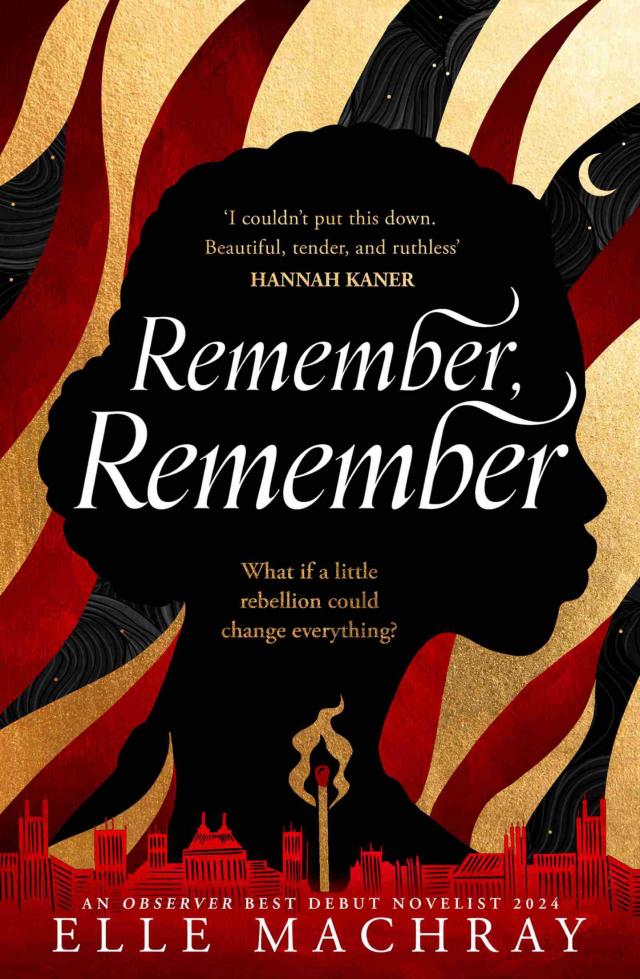


‘From the first page to the precious flicker of the last, Remember, Remember is an exquisite read. Meticulously rendered, deeply felt and full of fury, beautiful, tender, and ruthless. Elle Machray has created a novel steeped in history and the depths that love can go to. Machray is going to be a force to be reckoned with’ HANNAH KANER, #1 internationally bestselling author of Godkiller
‘Unforgettable … Will stay with you long after you’ve finished reading’ STACEY THOMAS, author of The Revels
‘Remember, Remember weaves together a masterful tapestry of resilience, love, and the pursuit of freedom. It’s a novel steeped in so much heartbreak yet so much beauty; a novel so compulsive in its plot yet so meticulous in its exploration of its characters’ emotional landscape’ ELVIN MENSAH, author of Small Joys
‘Deliciously evocative and atmospheric … Reminiscent of The Confessions of Frannie Langton and Pandora, Remember, Remember is immaculately researched and powerfully executed; a rousing war cry for justice from the past that feels every bit as urgent today. Machray expertly intertwines the high-stakes history of the era with compelling fiction and a rebellious heroine who gives a voice to the voiceless. The pace is cinematic and the characters pull you into their world with a breathless urgency. It’s punctuated with twists you don’t see coming; I was utterly gripped until the final explosive page!’ HAYLEY NOLAN, historian and #1 bestselling author of Anne Boleyn: 500 Years of Lies
‘Remember, Remember is a book we undoubtedly need right now – a rallying call to join the movement of contemplation, compassion, and action. With a setting both luscious and raw, and a defiant female lead, Machray reminds us all of the power we have within’ BRONWYN ELEY, author of the ‘Relic’ trilogy
Copyright
HarperNorth
Windmill Green
24 Mount Street
Manchester M2 3NX
A division of
HarperCollinsPublishers
1 London Bridge Street
London SE1 9GF
www.harpercollins.co.uk
First published by HarperNorth in 2024
1 EDITION
Copyright © Elle Machray 2024
Cover design by Micaela Alcaino © HarperCollinsPublishers Ltd 2024
Cover Illustration © Micaela Alcaino 2024
Dinkus and part title page illustrations: Shutterstock
Elle Machray asserts the moral right to be identified as the author of this work
This novel is entirely a work of fiction.
The names, characters and incidents portrayed in it are the work of the author’s imagination. Any resemblance to actual persons, living or dead, events or localities is entirely coincidental.
A catalogue record for this book is available from the British Library
All rights reserved under International and Pan-American Copyright Conventions. By payment of the required fees, you have been granted the nonexclusive, non-transferable right to access and read the text of this e-book on screen. No part of this text may be reproduced, transmitted, downloaded, decompiled, reverse engineered, or stored in or introduced into any information storage retrieval system, in any form or by any means, whether electronic or mechanical, now known or hereinafter invented, without the express written permission of HarperCollins e-books.
Find out about HarperCollins and the environment at www.harpercollins.co.uk/green
Source ISBN: 9780008559533
Ebook Edition © February 2024 ISBN: 9780008559540
Version 2024-02-14
Note to Readers
This ebook contains the following accessibility features which, if supported by your device, can be accessed via your ereader/accessibility settings:
Change of font size and line height
Change of background and font colours
Change of font
Change justification
Text to speech
Page numbers taken from the following print edition: ISBN 9780008559533
Dedication
For my nan,
thank you
Contents
Cover
Title Page
Copyright
Note to Readers
Dedication
Historical Note
Prologue
Part One: Liberty and Progress
Chapter One
Chapter Two
Chapter Three
Chapter Four
Chapter Five
Chapter Six
Chapter Seven
Chapter Eight
Chapter Nine
Chapter Ten
Chapter Eleven
Chapter Twelve
Chapter Thirteen
Chapter Fourteen
Chapter Fifteen
Chapter Sixteen
Chapter Seventeen
Part Two: Deeds, not Words
Chapter Eighteen
Chapter Nineteen
Chapter Twenty
Chapter Twenty-One
Chapter Twenty-Two
Chapter Twenty-Three
Chapter Twenty-Four
Chapter Twenty-Five
Chapter Twenty-Six
Chapter Twenty-Seven
Chapter Twenty-Eight
Chapter Twenty-Nine
Chapter Thirty
Chapter Thirty-One
Chapter Thirty-Two
Chapter Thirty-Three
Chapter Thirty-Four
Chapter Thirty-Five
Part Three: Knowledge and Revolution
Chapter Thirty-Six
Chapter Thirty-Seven
Chapter Thirty-Eight
Chapter Thirty-Nine
Chapter Forty
Chapter Forty-One
Epilogue
Acknowledgements
Book Credits
About the Publisher
Historical Note
Four generations after a failed attempt to destroy the British Parliament, an enslaved man, James Somerset, was to be transported from London to a Caribbean plantation.
He refused.
Somerset’s case was brought to trial in a time of social unrest. A revolution was brewing in America. Britain was rapidly industrialising, and its streets were fraught with protests against government corruption and unfair working conditions.
He won.
Somerset’s rebellion marked the beginning of the end of the transatlantic slave trade, altering the fates of approximately twenty thousand Black people living in Britain at the time and millions across the British Empire.
Though the events in this novel are fictionalised, and some alternative timelines have been used, Remember, Remember is inspired by his bravery and countless other tales of resistance.
Prologue
Ranelagh Pleasure Gardens, London, England
4th June 1766
Delphine emerges from the maze.
Thirty feet covered in an hour, the distance navigated in darkness, her thoughts scattered and uncountable as the stars.
She is free. She is tethered.
She escaped. She is devastated.
Delphine lifts her skirts and runs away from the orchestra’s bright rhythm, from the masses celebrating the King’s birthday, from the girl she left behind in those twisted hedges. Black grass slackens underfoot, now-stolen velvet slippers dampening and sliding on midnight dew.
A firework booms overhead, and she flinches, ducks beneath an exploding cartwheel of red and gold.
It is exactly as they’d planned, except Delphine is alone.
Aside from the two hundred boats crowding the Thames and the acrobats and the fire-breathers and the hot chestnut sellers, the wigged gentlemen dining in the rotunda, the harlots lining the balcony of the China House, the couples twirling between rows of lanterns to Mozart’s latest composition. They’re all out in celebration of His Royal Highness. Delphine hurries towards the boats, and a firework crackles again.
Though she should have expected it, the sound catches her off guard. Delphine stumbles. The violins quicken, and she glimpses His Majesty waving a stiff farewell to the crowd as she falls, bumping into the back of a woman in a most fashionably wide skirt. Yelping, the woman loses her balance and teeters into a nobleman, who collides into another, triggering a satin and lace-clad sequence of missteps. Delphine backs away as the French horns blare out four triumphant beats before the domino reaches the King.
All Delphine sees next is the tail of a ruby cloak falling into the murky water.
Submerged in glory, he emerges in a fury, shoving away helping hands from his amused wife and shocked King’s Guard.
Delphine hastens again, slipping behind an ash tree on the riverbank before a regal roar freezes her in place, silencing the orchestra’s crescendo. Dismissing his cooing entourage, His Majesty stamps a damp boot. Demands the event abruptly end. Decrees that no other carriages shall move until he has returned home and threatens to unleash a monarch’s wrath on any person, creature or peasant that gets in his way.
An altogether measured response for ruining his birthday.
King George III rides from Ranelagh, and Delphine is trapped.
The waterways are closed, and she must cross the river. Two hundred boats, but none will disobey the King. Her stagecoach leaves in two hours, and the station is four miles from here. Four miles between her and her only ticket out of the city.
This obstacle is not the beginning she was expecting. Already, her bones are tired, weary from anticipation and loss. But she keeps moving, asking every stationary sedan driver and half-sober pedestrian if they know a quicker route. Delphine steels herself against pickpockets and other nefarious night-dwellers as she journeys across London. She will carry on until she’s certain the coach has pulled away.
Delphine decided to leave the maze alone. Now, she chooses to race towards an uncertain future, to flee from her masters and inevitable heartbreak.
Part One
Liberty and Progress
Chapter One
Due to popular encouragement, V. ‘Freedom Fighter’ Mourière and D. ‘Quickfoot’ Turner will return to the theatre this evening to exhibit the ‘Art of Boxing’. With both men’s reputations on the circuit eclipsing the celebrity of boxers of yesteryear, the evening’s entertainment promises to be the most exciting fight of the season.
—LONDON GAZETTE
Delphine
Theatre Royal, Covent Garden, London
6th May 1770
There are too many hats in Covent Garden. Too many tricornes tilted in the shadows, passing secrets to fluttering lace fans. Delphine hates the sconces, too. The whispers spread through their flames. You’re not welcome here, they seem to hiss beneath the moonlight. Most evenings, she’d add an extra turn to her journey to avoid the place, but tonight…She traces her fingers over the ticket in her pocket – the smooth parchment and the promise she and her brother made long ago settles her thoughts.
‘Même bête, même lam,’ she whispers, the Patois falling from her tongue like a fading dream. Same beast, same soul. A vow to share each other’s successes and lighten each other’s burdens. Vincent didn’t hesitate when he presented Delphine with a pit-entrance ticket for his final match. She had to be here.
But the more pressing question is: how to get in?
Two door bullies guard the Theatre Royal’s grander entrance. The red-lipped ladies of the night and stiff-lipped ladies of society drape themselves on wealthy men’s arms in near equal attendance. Head bowed, Delphine skirts past them and their jasmine perfumes. The sweet scent is swiftly replaced by sour ale as she glances around the corner, where poorly-tailored shopboys and off-duty traders stagger towards an alleyway.
The passage to the pit?
She turns back to the door bullies and begins asking if this is the correct entrance when a group of gentlemen barge into her, piling silk coats and nivernois in her arms before she can finish her question. It’s her own fault, of course. She shouldn’t be lingering by the front door if she didn’t want to be mistaken for a servant. Now, there are four options. First, Delphine could interrupt their passionate discussion about some radical MP’s release from prison and inform the men that she does not work here. They would probably ignore her and carry on their conversation.
Secondly, she could run off with their possessions – the silk is soft as a newborn’s skin, the floral embossments rather lovely – and sell them to the nearest peddler. She’d make a few coins, certainly, but would also risk hanging. Not preferable.
Or she could chuck the items on the ground. This would probably get their attention, but then the door bullies would deny her entry for such improper behaviour.
With a resigned purse of the lips, Delphine chooses to say nothing. She wipes her feet before following them into the theatre’s glimmering lobby. Passing between two of the four Palladian columns, she cranes her neck over the pile to glimpse golden chandeliers raining light on the gentlemen’s coiffed white wigs. Ahead, muscular statues of men she’s probably never heard of flank a staircase that flows like a marble waterfall into a pool of ivory tiles.
The men saunter past the stairs towards the bar, another servant deftly scrubbing the muddy trail left behind them. Delphine veers off to the right, briefly admiring a life-size painting of white women dancing unashamedly in a forest and another of two pale red-coated men with long swords drawn, before she reaches the oak-panelled cloakroom. Once her assigned role of portable coat rack has been fulfilled, she’ll find a shadow to retreat into, a Black woman invisible once more.
‘Odds are on the Freedom Fighter,’ one of the cloakroom attendants says as Delphine drops the belongings on the desk, a queue of bored footmen and assistants tapping their boots behind her.
‘He’s getting on, though,’ the older attendant chirps, not looking at her as he dusts off the hats, plucking stray hairs from each one. ‘Quickfoot’s undefeated this season.’
‘Mourière has more to lose – you ever seen him fight when he’s down? It’s that Carib hoodoodoo, I swear, possesses him. I seen it me self.’
As the younger one hands over the cloakroom stub, Delphine summons all the hoodoodoo she has to keep her face blank. Along with invisibility, restrained compliance is another power Delphine’s acquired over her one-and-twenty years. Both have been vital for avoiding capture since she escaped enslavement. A stark contrast to her brother, whose boxing prowess has made him one of the most famous Negroes in London.
After discarding the cloakroom stub behind a potted fern, Delphine swipes a tray of champagne flutes from the bar as recompense for her earlier humiliation. If anyone asks, she’ll say she’s delivering it to her master and his guests. But the barman is disinterested; she points vaguely at some spectators milling past, he nods, and she slips away with her drinks, between rustling skirts and cackling laughter, back through the packed lobby.
She’s gambling with her freedom by coming here tonight. If one of Lord Harvey’s acquaintances recognises her, they could force her to return to 20 St James’s Square. It’s not happened so far – her master’s guests rarely paid Delphine much attention – but today could be the day. And it is reckless to risk being caught for something as frivolous as stealing champagne.
But these little rebellions, as her mother used to call them, the choices so small, so subversive, that others barely notice them – until it’s too late – are everything to Delphine. The threat of the noose has always shadowed her, but she’s learned to find light between its threads. These little rebellions are just enough to remind her she is more than her fear. Tray in hand, Delphine rounds the corner to a quiet hallway and lifts two glasses, leaving the rest on an abandoned table. With her back against the wall and a quick glance around, she drains the first glass, then the second, savouring the tartness of the bubbles before re-joining the crowd and heading towards the low hum of the pit.
Vincent
Vincent watches the seconds tick by in his dressing room. The problem with time, he thinks, is there are always too many seconds when you don’t want them and never enough when you need them. His right leg bounces against the scratched bench he sits on. It stops. Then, the left leg begins again, repeating the cycle.
Impatient, he groans as he rises before striding to the mirror. Looping his arms behind his head, he mutters words of self-encouragement, hot breaths fogging up the frameless glass. As the mist fades, he says to his outline, ‘One more fight.’
Truly, he didn’t expect this day to come. Every bruise, broken nose, and coin Vincent has earned has been for this night – his emancipation. The excitement fizzes in his throat. He swallows it back down, afraid it might escape.
Of course, his master hadn’t said it would be tonight, but Vincent’s worked it all out: the odds, the scales, everything. It is better to arrange his future in advance than rely on Lord Harvey – with his shoddy calculations and tendency to add new conditions to unwritten promises. But there’s no changing their contract. His master’s terms are filed safely away, set and dried in ink: win your weight in coin, and you’ll be free.
Vincent is nineteen pence short.
If he bests today’s opponent, it will even give Lord Harvey some change.
He jabs in the air, waking the blood in his tired muscles. All he has to do now is win.
‘You’re on in two, Mourière,’ the match announcer says through the door.
He breathes out, takes another lap around the windowless room, and sighs at the day’s mint green livery suit and obnoxiously ruffied shirt hanging from the coat hook. After tonight, he’d like to throw every pastel garment into the Thames.
Although the building is but forty years standing, the Theatre Royal’s back rooms have fallen into disrepair. The walls are yellowing and sweat-scented. A plant lies withered beyond recognition on his crooked dressing table, its leaves so curled and brown that he doubts even his herbalist sister could revive it. If he weren’t so excited, the dreariness of the place might dampen his mood. It can be easy to let the decay seep into his thoughts when left alone. Often, the worst fights are with himself.






