

Winter, p.1
Winter, page 1


Len Deighton
Len Deighton was born in 1929. He worked as a railway clerk before doing his National Service in the RAF as a photographer attached to the Special Investigation Branch.
After his discharge in 1949, he went to art school – first to the St Martin’s School of Art, and then to the Royal College of Art on a scholarship. His mother was a professional cook and he grew up with an interest in cookery – a subject he was later to make his own in an animated strip for the Observer and in two cookery books. He worked for a while as an illustrator in New York and as art director of an advertising agency in London.
Deciding it was time to settle down, Deighton moved to the Dordogne where he started work on his first book, The Ipcress File. Published in 1962, the book was an immediate success.
Since then his work has gone from strength to strength, varying from espionage novels to war, general fiction and non-fiction. The BBC made Bomber into a daylong radio drama in ‘real time’. Deighton’s history of World War Two, Blood, Tears and Folly, was published to wide acclaim – Jack Higgins called it ‘an absolute landmark’.
As Max Hastings observed, Deighton captured a time and a mood – ‘To those of us who were in our twenties in the 1960s, his books seemed the coolest, funkiest, most sophisticated things we’d ever read’ – and his books have now deservedly become classics.
By Len Deighton
FICTION
The Ipcress File
Horse Under Water
Funeral in Berlin
Billion-Dollar Brain
An Expensive Place to Die
Only When I Larf
Bomber
Declarations of War
Close-Up
Spy Story
Yesterday’s Spy
Twinkle, Twinkle, Little Spy
SS-GB
XPD
Goodbye Mickey Mouse
MAMista
City of Gold
Violent Ward
THE SAMSON SERIES
Berlin Game
Mexico Set
London Match
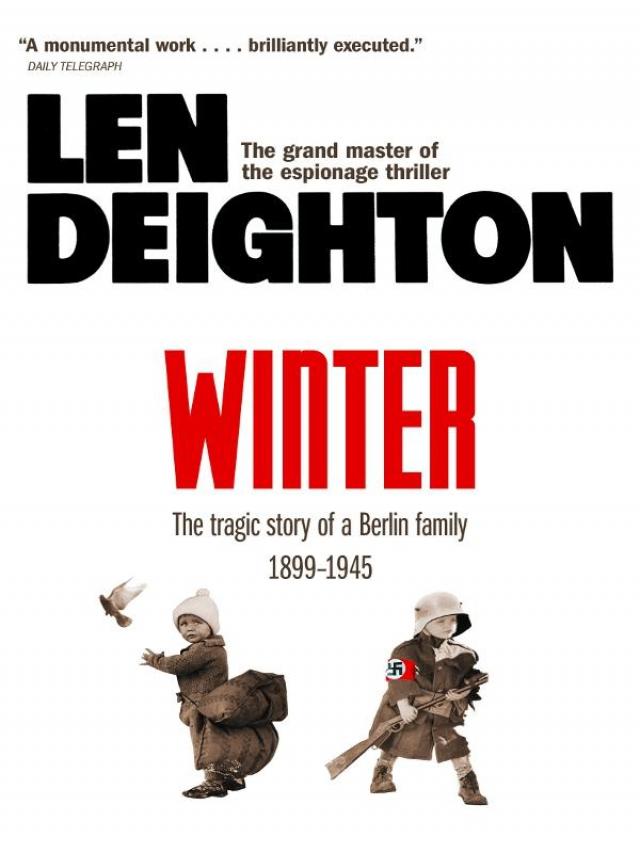
Winter: The Tragic Story of a Berlin Family 1899–1945
Spy Hook
Spy Line
Spy Sinker
Faith
Hope
Charity
NON-FICTION
Action Cook Book
Fighter: The True Story of the Battle of Britain
Airshipwreck
French Cooking for Men
Blitzkrieg: From the Rise of Hitler to the Fall of Dunkirk
ABC of French Food
Blood, Tears and Folly
LEN DEIGHTON
Winter
The Tragic Story of a Berlin Family 1899–1945
An Imprint of Sterling Publishing
387 Park Avenue South
New York, NY 10016
STERLING and the distinctive Sterling logo are registered trademarks of Sterling Publishing Co., Inc.
First Sterling edition 2011
First published in Great Britain by Hutchinson Ltd in 1987
© 1987 by Len Deighton
Introduction copyright © 2010 by Pluriform Publishing Company BV
The author asserts the moral right to be
identified as the author of this work.
All rights reserved. No part of this publication may be reproduced, stored in a retrieval system, or transmitted, in any form or by any means, electronic, mechanical, photocopying, recording, or otherwise, without prior written permission from the publisher.
ISBN 978-1-4027-9501-5 (ebook)
For information about custom editions, special sales, and premium and corporate purchases, please contact Sterling Special Sales at 800-805-5489 or specialsales@sterlingpublishing.com.
www.sterlingpublishing.com
Contents
Introduction
Prologue
1899
1900
1906
1908
1910
1914
1916
1917
1918
1922
1924
1925
1927
1929
1930
1932
1933
1934
1936
1937
1938
1939
1940
1941
1942
1943
1944
1945
Introduction
This is how it started. It was Friday afternoon – exactly 2.20 pm – and the snow was falling. The flakes that hit the car’s windscreen were not the soft, watery sort that slide downwards and fade away like old soldiers. These were solid bullets of ice, perfectly formed and determined to stay put. These were German snowflakes. Our elderly Volvo was on the road heading west from Munich, with the cold waters of the Ammersee close at hand and my sons on the back seat politely starving to death. My wife was at the wheel. ‘The next place we see; we stop,’ I said. ‘It’s getting late. I don’t care if it’s just a currywurst van parked on the roadside.’
The ‘next place’ was the Gasthof Kramerhof. It was a typical Bavarian inn, with a large restaurant that attracted locals and a few well-kept rooms for travellers. It was sited well back from the road and had an extensive parking area, which is often a measure of an inn’s popularity. Now lunchtime had ended and there were no cars there. The loops of tyre tracks that marked their departure were now disappearing under the continuing snowfall. But in such a Gasthof all travellers are welcome and mealtime lasts all day. Soon we were relishing a Bavarian meal: kraftbrühe – clear soup – followed by pork cutlets in a sour cream sauce with spätzle on the same plate. Had I been better informed about German food I might have guessed that the owners were Schwabs, for these were the long square-sided ‘pasta’ that is a delight of Schwabian cooking.
Outside, the snow was conquering the world. The sky was steely grey and descending upon the treetops. Stacked on the Volvo’s oversized roof rack, our bags and boxes now looked like a scale model of the Alps. What else was there to do? We stayed there for the weekend. That’s all it took for the Kramerhof to become our home and we remained there for many months. From the hotel room we moved one floor higher where I set up my portable typewriter in the attic rooms originally furnished for a mother-in-law. It was cramped under the steeply sloping roof and I banged my head a lot but this was the sort of Germany I wanted to write about. All the events of the neighborhood were celebrated there under our noses, from weddings – complete with amateur brass band – to hunting-dinners from which the smell of wine-rich venison drifted upwards to reach us in the early hours of morning.
My wife’s fluent German impressed the lady in the village post office and we soon knew everything about everyone. There was enough social life to furnish a dozen lurid novels. Retired military men abounded. I met a relative of General Gehlen, one of the very few spies who influenced history. The Kramerhof food was wonderful, the customers were entertaining and the owners became friends. They allowed us into the well-ordered kitchen where we learned how to make Schwabian spätzle and much more.
Winter was a biography of the Germany I had come to know over the years. We had lived in Vienna and in an Austrian village near Salzburg, which was now not all that far away, and my sons spoke a strongly accented German. For many Germans, and many historians too, Germany and Austria do not have a separate existence. AJP Taylor, who taught me so much about German history, persuaded me to consider both in unison and for that reason the story of Winter begins in Vienna. One of our neighbours in Riederau village had a son writing for a newspaper in Vienna. At my request, he rummaged through the archives to find out what the weather was like in Vienna on ‘the final evening of the 1800s’. Now I had no excuse for delay.
I knew what I wanted to say; I had been planning it for years. My hesitation had come from the problems of continuity. In the beneficial absence of formal instruction in the skills of writing fiction, I found it natural to write sequences in ‘real time’. In my book conversations and physical actions as depicted were apt to take about the same time as the reader took in reading about them. Of course there were expansions and compressions so that only the highlights of dinner party chit-chat were necessary; split-second reactions were expanded to encompass thought and reactions. But now I was going to relate the events of fifty years; I faced many problems I never even guessed about. Somerset Maugham, a writer I much admired, would often write in the first person of a man who observed the events of which he wrote. Maugham’s voice was apt to bridge his narrative with ‘. . . it was three years before I was to see either of them again, and it was in very different circumstances’. As a reader I rather delighted in this voyeur writer but I didn’t feel confident enough to use such leaps in time. And the frantic pace of German history would not survive a leisurely survey.
I sought advice from my literary agents Jonathan and Ann Clowes – the most widely read friends I have – and examined several family saga novels, old; and new. There was a lot to learn. More than once I decided to abandon my project but while I was sorting and sifting my research notes the solution became evident. I would eliminate connective material. My chapters would be brief human interactions, like flashes of lightning illuminating long nights of darkness. This format would require careful selection of material so that each chapter provided a vital link in the story. And yet Winter must not be a history book; it had to be an interesting and emotive story of a family living through Europe’s nightmare past.
< br /> I returned to Vienna. Vienna is a town different to any other that I know. The small central area is defined by the Ringstrasse around which, according to his son, the amazing Sigmund Freud ‘marched at a terrific speed almost every day’. Vienna is not so much a town as a spectacle: if you don’t want to visit Sankt Marxer Friedhof – where Mozart’s corpse was tossed into a common grave – you can chew on the famous chocolates that bear his name. If you don’t like the music of Mahler, what about Franz Lehar? If Klimt is too opulent, what about Schiele? If you don’t like the Hotel Sacher; savour your Sachertorte in Demels. If you don’t fancy Graham Greene’s sewers; seek Harry Lime on the big wheel in the Prater. Vienna has something for everyone; from the Wiener Werkstätte to the Wienerwald. Within the Ringstrasse there are more churches, historic buildings, restaurants and shops than anyone needs. But the greatest wonders of the city are its magnificent old cafes. So you can see why, for anyone inflicted with nsatiable curiosity, or easily diverted, Vienna is no place to write books.
I chose Munich because that city uniquely links Vienna with Berlin. The inhabitants of these three great German cities view each other with dispassionate superiority. While the mighty Austria-Hungary Empire dominated Europe, Vienna ruled. It was Bismarck, and the Prussian armies that in 1870 marched into Paris, that displaced Vienna and established Berlin’s ascendancy. At the turn of the century, Berlin’s music hall comics got guaranteed laughs from jokes that depicted Bavarians and the Viennese as hopeless country bumpkins. But Hitler changed all that. Hitler was an Austrian and his Nazi Party was born in Munich and when Hitler named that town as the Hauptstadt der Bewegung – ‘capital of the movement’ – all jokes about its citizens were hushed.
I visited all three cities frequently while working on this book but Munich was the place where it all began. My sons attended a local boarding school at Schondorf, and put their Austrian accents on the shelf. With the aid of my wife, I interrogated anyone old enough to provide me with memories of the old days. I was listening to the recollections of a fellow customer in a stationery shop when I spotted a small grey ‘typewriter’ that turned out to be Hewlett Packard’s radical new product. It was the world’s first laptop: a unique, strange and awkward beast by today’s standards – and started writing.
Len Deighton, 2010
Prologue
Nuremberg 1945
Winter entered the prison cell unprepared for the change that the short period of imprisonment had brought to his friend. The prisoner was fifty-two years old and looked at least sixty. His hair had been thinning for years, but suddenly he’d become a bald-headed old man. He was sitting on the iron frame bed, sallow and shrunken. His elbows were resting on his knees and one hand was propped under his unshaven chin. The prison authorities had taken from him his belt, his braces, and his necktie, and the expensive custom-made suit from Berlin’s most famous tailor was now stained and baggy. And yet the dark-underlined eyes were the same, and the pointed cleft chin made him immediately recognizable as a celebrity of the Third Reich, one of Hitler’s most reliable associates.
‘You sent for me, Herr Reichsminister?’
The prisoner looked up. ‘The Reich is kaputt, Germany is kaputt, and I’m not a minister: I’m just a number.’ Winter could think of no way to respond to the bitter old man. He’d become used to seeing him sitting behind the magnificent hand-carved desk in the tapestry-hung room in the ministry, surrounded by aides, secretaries, and assistants. ‘Yes, I sent for you, Winter. Sit down.’
He sat down. So it was all to be formal.
‘I sent for you, Herr Doktor Winter, and I’ll tell you why. They told me you were in prison in London awaiting interrogation. They said that any of us on trial here could choose any German national we wanted for our defence counsel, and that if the one we chose was being held in prison they’d release him to do it. It seemed to me that a man in prison might know what it’s like for me in here.’
Winter wondered if he should offer the ex-Reichsminister a cigarette, but when – still undecided – he produced his precious cigarettes, the military policeman in the corridor shouted through the open door, ‘No smoking, buddy!’
The ex-Reichsminister gave no sign of having heard the prison guard’s voice. He carried on with his explanation. ‘Two, you speak American . . . speak it fluently. Three, you’re a damned good lawyer, as I know from working with you for many years. Four, and this is the most important, you are an Obersturmbannführer in the SS . . .’ He saw Winter’s face change and said, ‘Is there something wrong, Winter?’
Winter leaned forward; it was a gesture of confidentiality and commitment. ‘At this very moment, just a few hundred yards from here, there are a hundred or more American lawyers drafting the prosecution’s case for declaring the SS an illegal organization. Such a verdict would mean prison, and perhaps death sentences, for everyone who was ever a member.’
‘Very well,’ said the prisoner testily. He’d always hated what he called ‘unimportant pettifogging details’. ‘But you’re not going to suddenly claim you weren’t a member of the SS, are you?’
For the first time since the message had come that the minister wanted him as junior defence counsel, Winter felt alarmed. He looked round the cell to see if there were microphones. There were bound to be. He remembered this building from the time when he’d been working with the Nuremberg Gestapo. Half the material used in the trial of the disgruntled brownshirts had come from shorthand clerks who had listened to the prisoners over hidden microphones. ‘I can’t answer that,’ said Winter softly.
‘Don’t give me that yes-sir, no-sir, I-don’t-know-sir. I don’t want some woolly-minded, fainthearted, Jew-loving liberal trying to get my case thrown out of court on some obscure technicality. I sent for you because you got me into all this. I remembered your hard work for the party. I remembered the good times we had long before we dreamed of coming to power. I remembered the way your father lent me money back when no one else would even let me into their office. Pull yourself together, Winter. Either put your guts into the effort for my defence or get out of here!’
Winter admired his old friend’s courage. Appearances could be deceptive: he wasn’t the broken-spirited shell that Winter had thought; he was still the same ruthless old bastard that he had worked for. He remembered that first political meeting in the Potsdamer Platz in the 1920s and the speech he’d given: ‘Beneath the ashes fires still rage.’ It had been a recurring theme in his speeches right up until 1945.
‘We’ll fight them,’ said Winter. ‘We’ll grab those judges by the ankles and shake them until their loose change falls to the floor.’
‘That’s right,’ he said. It was another one of his pet expressions. ‘That’s right.’ He almost smiled.
‘Time’s up, buddy!’
Winter looked at his watch. There was another two minutes to go. The Americans were like that. They talked about justice and freedom, democracy and liberty, but they never gave an inch. There was no point in arguing: they were the victors. The whole damned Nuremberg trial was just a show trial, just an opportunity for the Americans and the British and the French and the Russians to make an elaborate pretence of legal rectitude before executing the vanquished. But it was better that the ex-Reichsminister didn’t fully realize the inevitable verdict and sentence. Better to fight them all the way and go down fighting. At least that would keep his spirits alive. With this resolved, Winter felt better, too. It would be a chance to relive the old days, if only in memories.
When Winter got to the door, the old man called out to him, ‘One last thing, Winter.’ Winter turned to face him. ‘I hear stories about some aggressive American colonel on the prosecution staff, a tall, thin one with a beautifully tailored uniform and manicured fingernails . . . a man who speaks perfect German with a Berlin accent. He seems to hate all Germans and makes no allowances for anything; he treats everyone to a tongue-lashing every time he sends for them. Now they tell me he’s been sent from Washington just to frame the prosecution’s case against me . . .’ He paused and stared. He was working himself up into the sort of rage that had sent fear into every corner of his ministry and far beyond. ‘Not for Göring, Speer, Hess, or any of the others, just for me. What do you know about that shit-face Schweinehund?’






