Into the hands of evil, p.1
Into the Hands of Evil, page 1


Into the Hands of Evil
“Is this seat taken?” asked a young, well-dressed businessman as he pointed down to the brown leather seat of the train.
“No,” was the reply, spoken by an old man who had been daydreaming out through the train window. His head was mostly bald, and the gray hair that remained was cut very short. He politely moved his bag to the right side of his right leg, so as to lean it against the wall of the rail car.
“I would bet you are on holiday,” said the businessman cheerily, “I take this route often and I don’t believe I have seen you.” The businessman feared that he spoke rudely and began again, “I mean you seem also to be enjoying the trip. I would be hard-pressed to say the same.” Again he thought he had come off badly, but it was not intentional and he did not intend to ponder it.
“It has been thirty-one years since I last rode these rails,” said the balding man, with eyes that betrayed no emotion. “My last trip was…unsuccessful.” His vision did not focus upon any one thing as he spoke these words.
“Not successful…?” said the businessman. “Do you mean a malfunction of the locomotive?”
The balding man turned to look at his young companion for the first time since first they had spoken. “I don’t know the cause of it, but it was mechanical in nature I do believe. And it wasn’t the snow,” he grumbled, “but there was one hell of a storm blowing about. But myself and my companion Carl, being only twenty-four at the time would sooner have feared a flock of pigeons, ha!”
The businessman relaxed a bit now, having decided his seatmate was not to be taken seriously, and was perhaps just an old fool. “Well we’ll not have that problem tonight sir,” he said and smiled largely to sooth the old man. “There’ll be no harsh weather to fear.” The businessman took out his newspaper and opened pages two and three widely in front of his chest.
“But the weather was not so harsh as the true evil we did encounter.” The old man turned inward to his seatmate and stared at him now, and continued in a lower voice.
“You see we were not legal passengers all that time ago, but rather shipping car stowaways. When the malfunction came and the car rolled to a stop, we waited for several minutes until we felt it was safe to emerge. We listened until we had heard the workman dismounting, and their voices trailed off down the tracks. Only then did we slip from our hiding place and follow their tracks back in the direction we had come. But those men had provisions and traveling gear, whereas we had nothing at all. Carl, my companion, was a bit of a headstrong fool. And my name, young sir, is Jack Rollin.
The businessman folded his paper upon his lap and waited intently for the old man to speak again…
“This track runs east-west,” said Carl as he pulled on his knit cap amidst the snow. “Thirty miles west of the station there’s a small village called Hamburg. I say we had traveled near forty miles from the station before the train stopped, and I reckon we ought to veer northward.”
Jack looked to his left at the north sky and saw only the whiteness of the storm. The men continued walking eastward through the snow as they debated. “I saw you nod off while in that car,” said Jack gruffly. “You cannot know if we’ve traveled forty miles or seventy.”
Carl, a larger man than Jack, set their pace with his long strides. “We can’t cover forty miles of track back to the station before dusk. That leaves only the option of begging those men up yonder for a share of their fire and shelter when they stop for the night, if they stop for the night. You and I won’t last a night out here walking in these clothes.”
“I see nothing north of here but frigid fields,” said Jack as he tucked his chin back down in the collar of his shirt.
“Hamburg is just north of us,” assured Carl. “I bet my life on it. Even if I am wrong by five miles, we’ll cross the farmer’s roads and follow them on in. It shan’t be more than a ten-mile trek at the most.”
“Back in that rail car with the straw and a closed door would not be such a rough night,” said Jack.
“We’ll walk five miles north. If we encounter no road to Hamburg, we’ll turn right around and sleep in the rail car. Give me ten miles, Jack, and I’ll get you a warm bed and a warm plate of hash.”
Jack pulled his chin out and looked north again. “All right, five miles north,” he said gruffly, and nothing thereafter.
The snow continued to fall, and this was not as much of a hindrance as the bite of the frigid wind. Neither man spoke as they trudged along, and they soon fell into the pattern of the smaller Jack following the lead of Carl. Jack’s fear grew as the air before them grew darker, with nothing but endless fields of white freezing death inviting them to lie down and die. But he spoke not a word of this, feeling fearful of displaying this weakness to the man who led him along. Instead he bit down on his back teeth and breathed deeply from the freezing air.
In his mind he had already decided that he would walk one more mile before turning back around. He prepared the words within his mind, pondering the best way to speak them so as to not to be an outright coward. It was just then that Carl halted and regained the posture of a confident man.
Aye, we’ve found it!” yelled Carl, with a shrill voice of excitement that betrayed his recently disposed of fear. “Do you see the wagon wheel ruts in the snow, surely not but two hours ago?”
“Aye, but which way did they travel?” said Jack. He scanned the eastward horizon and then the west. “The hoof prints are now all full.”
Carl was silent having realized this also. His decision of direction could now determine their very existence, for with the snow still falling they would not again find the footprints that they had just made.
They trod eastward,” said Carl, “I am near-certain this is true.” He did not look into Jack’s eyes as he said this, and began his new direction. He did not turn to see if Jack followed, but felt relief at hearing the noise of footfall behind.
Jack looked around for an object to mark the intersection where they had made this directional turn. He saw nothing at all of distinction. He thought briefly of pissing a bright yellow marker but saw Carl disappearing rapidly into the great whiteness. He dismissed the notion and ran quickly forward, returning to the heels of his companion.
Two miles further the sun was preparing to set and Jack felt certain that all hope was lost. He no longer cared about showing cowardice, and thought hard about declaring a retreat. With every step the words grew nearer to flying out of him, when Carl cried out suddenly with glee.
“Ahead now! I see the dark outline of a dwelling!” Jack peered around his large companion and saw with his own eyes that it was true. They ran toward it until they were within thirty feet, and then walked with their dignity outward. Signs of life, however, were not imminent. Carl stepped upon the wooden porch, which gave a faint creek, and then knocked firmly but politely upon the door.
“If it’s abandoned,” spoke Jack, “then we’ll be forced to break in for the night.”
And then there was sound from within and the thick wooden door swung outward exposing the enormous face of a man. His forehead was broad and his eyes sunken and narrow. If the travelers had not been so chilled already, they would have felt this man’s ugliness with a cold shiver down their spines.
“Yes,” came the ugly man’s voice, with a bit of surprising charm. He stood eye to eye with Carl, but it seemed to Jack that the man did slouch within his doorway.
“Excuse my sir,” said Carl very lightly as he held his woolen hat up to his sternum. “Our train had a malfunction, and we are now on foot to Hamburg. Could you tell me please how near we are or if there is a boarding house nearby?”
The ugly man did not answer, and neither did his eyes yet appear from the darkness of his overhanging brow. Instead the door opened wider and a woman appeared beneath the man’s arm. She was not so unpleasant to view as the man, but neither did she have any noticeable pleasantness to speak of. She seemed to Jack and Carl to be the plainest woman they had ever encountered.
“Hamburg is five miles east of here,” she said with a voice that smelled of cigar tobacco. “You’ll not be getting there before dark. But we have a room for you. Only one, you’ll have to share. And it will be thirty cents apiece- thirty-five if you’d like dinner and tea.”
“Agreed, ma’am,” said Carl, still holding his cap so dearly and speaking with his charming voice. The ugly man stepped back into his dark house and the woman held the door widely.
Once inside she lit an oil lamp and halted them at the foot of an aged wooden staircase. She gave them the lamp and instructed them to their room, noting that they could pay at dinner. She then turned to her husband who stood lurking nearby, and said to him a touch sternly, “Yes, prepare a guest dinner.” Neither man delayed their ascent, as Carl led the way and shined the light up the stairway.
“I’m not hungry,” said Jack as Carl set the lamp upon the table within their room. “I’ll be content to warm myself by that fireplace once I get it started. My stomach feels a bit ill.”
“Not mine,” said Carl. “Let’s have that thirty cents, then. I’ll pay it for you when I go down.”
“Here,” he answered, and then a silence came between them for a moment. “The town is only five miles, the woman said. That seems… comforting to me… somehow.” He looked at his large friend and felt confusion at why he had felt compelled to speak those words.
“I’m starved,” said Carl, and then, “We’ll see what a five-cent dinner entails out here in the middle of nowh ere.” He was out the door without another word and Jack listened to his footsteps trod down the warping stairway.
A small fire was soon roaring and he lay there in his chair watching shadows dance upon the wall. He tried in vain to hear the sounds of the dinner below. As his blood warmed, a feeling brewed within him for which he could not readily find a source. It was the feeling of dread which sprang upon him suddenly, growing first in some dark region of his innards, and then creeping through every capillary and vein until it claimed the entirety of his entire body.
The shadows came alive on the wall before him, and he saw the plainness of that woman’s face. It was as plain as their simple wooden house, which sat in the middle of their plain white field. This shadow face soon molded into a new form, and within it appeared the brow and seemingly eyeless face of the enormous man. These shadows upon the walls consumed him, and surrounded him from every side. Their dance never rested as the flames of the hearth pranced about, constantly guided by a draft that flowed from a crack unseen. Jack hoped very strongly that Hamburg were truly only five miles to the east.
After the shadows had played their game upon him, Jack rethought his decision about dinner, and went quickly from his chair. He did not take the time to don his boots, and crept softly down the wooden steps. I will just excuse myself for having delayed, he thought, and felt happy that he would again be along side cheerful Carl. For it was simply the cold that had brought on his hysterics, he reasoned, and thought certainly that companionship would cure him.
Jack realized that he did not have his five cents extra, for his money was in his workman’s coat. He would simply apologize earnestly and pay promptly after the meal.
And with this joy in his belly he rounded the corner of the ground floor and ambled toward the light he saw. Already he heard the sounds of conversation, and he was thoroughly glad that he had reconsidered.
He stepped into the room and saw Carl seated across from the plain woman, whose face he secretly loathed. Both sat at a large table, where his friend ate from a bowl with apparent great hunger as the plain woman’s chatter filled the air. She seemed to be speaking of an event, perhaps their harvest from the year before.
A sheet had been hung strangely across the room, from which the woman sat directly across. Carl showed it only his back as he devoured the hot food he had been given. Beside him Jack saw an empty chair where the woman had intended for him to sit.
Jack reasoned that the sheet was meant as a curtain, for perhaps these poor farmers felt shame for their pitiful house. And as peculiar as the sheet appeared, it seemed to Jack as quite logical, for the house had fallen badly into disrepair. He accepted this explanation and thought only of joining his companion and taking a portion of the remaining meal.
Carl and the plain woman both turned their heads to view him as he stepped from the darkness of the hall. Jack’s hysteria had subsided nearly completely, until he looked to the face of the woman. Her plainness had been replaced by a peculiar expression which displayed irrefutable concern. The panic washed over Jack again in a torrent, and filled him with the dread once again.
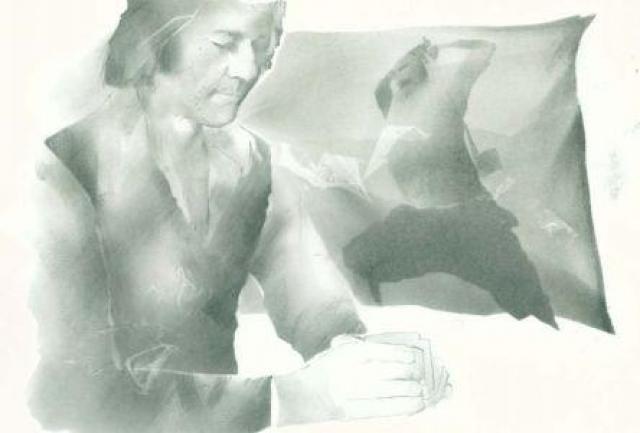
Before a word could be spoken a great shadow appeared suddenly on the opposing side of the sheet which divided the room. Through it Jack saw the large image of the man, who held something sizeable within his grasp.
Jack peered again to the plain woman and saw that the concern in her eyes had grown in intensity. Her glare pierced him like needles, with an evil he had never before seen. She turned from him suddenly and looked upon the curtain just as the great shadow drew up its arms. The hands of the figure now held the shape of a massive hammer, drawn back and ready to swing.
“Carl!” shouted Jack, as he threw out his hand, and the woman leapt from her chair. The thin curtain heaved forward and came to life, as a sickening thud sounded through the air. Jack could only watch as his companion’s head fell forward and onto the table. The body of his friend never moved again and lay with lifeless certainty. The hot blood flew outward in a wave of death, landing most visibly upon the white of the sheet. It became, before Jack’s eyes, the deep crimson color of fresh blood from a slaughter.
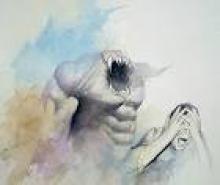
“The other!” shrieked the plain woman as she pointed her knobby finger to Jack who stood now within the room. The curtain was torn from the ceiling with the slash of a giant hand. The terrible body of the murderous man appeared, with the sledgehammer still firmly within his grasp. The evil within his black sunken eyes made him appear like a creature from hell.
Jack struggled to move his feet but found them frozen, as though trapped in a horrid dream. They would not heed his commands as the man stalked forward, and from the hammer ran a trickle of blood which fell upon the rotting boards of the floor.
The sight of the hammer freed his legs and like a shot he ran from the room. Jack ripped the thick wooden door open with the strength of twenty men, and fled out into the storm. He was without boots, nor hat, nor coat, but he did not feel the cold. Not as he ran into the darkness, instinctively to the east, toward the village of Hamburg if it did exist there. And all the while he was certain, that at any moment the great hammer would come crashing down upon him, opening his skull and dyeing the snow that same crimson color…
Hamburg did indeed exist,” said Jack Rollin, “And there were perhaps truly five miles in between, but I certainly was in no mind to be able to confirm that for certain.”
Beside him the young businessman clutched tightly to his newspaper, not realizing that he did so.
“Yes, I made it there and pounded upon the first lighted house that I did see. But it was not until the first daylight of the next morning that the men folk would ride to that terrible house. And although I felt great guilt for having failed to save my friend, I did not press the urgency for I knew that he was dead.
In the morning the town’s men found the house to be quite empty except for my friend’s remains… For the man and woman had fled on horseback and freshly fallen snow had covered their tracks. The story became national news briefly, and was featured in every newspaper throughout the land. I can only assume that they had been after our money, but truthfully we were more destitute than they. And nothing more of the pair was ever learned, except for four shallow graves found out behind their barn, belonging to four other nameless victims…
The End
Chris Robertson, Into the Hands of Evil
Thanks for reading the books on GrayCity.Net