The blood divide, p.1
The Blood Divide, page 1


A. A. Dhand
* * *
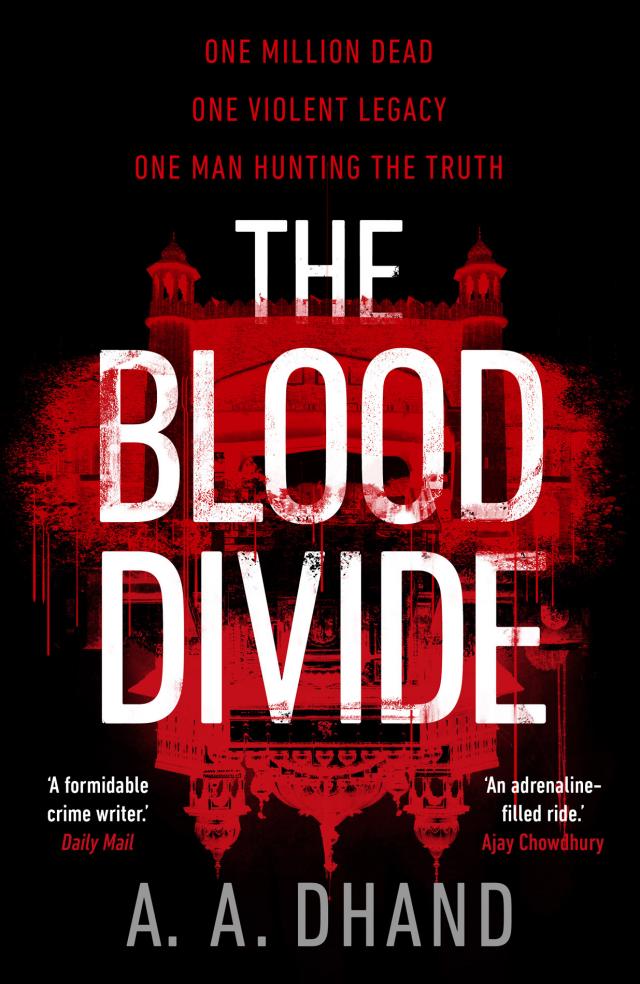
THE BLOOD DIVIDE
Contents
PROLOGUE
PART ONE CHAPTER ONE
CHAPTER TWO
CHAPTER THREE
CHAPTER FOUR
CHAPTER FIVE
CHAPTER SIX
CHAPTER SEVEN
CHAPTER EIGHT
CHAPTER NINE
CHAPTER TEN
CHAPTER ELEVEN
CHAPTER TWELVE
CHAPTER THIRTEEN
CHAPTER FOURTEEN
CHAPTER FIFTEEN
CHAPTER SIXTEEN
CHAPTER SEVENTEEN
CHAPTER EIGHTEEN
CHAPTER NINETEEN
CHAPTER TWENTY
CHAPTER TWENTY-ONE
CHAPTER TWENTY-TWO
CHAPTER TWENTY-THREE
CHAPTER TWENTY-FOUR
CHAPTER TWENTY-FIVE
CHAPTER TWENTY-SIX
PART TWO CHAPTER TWENTY-SEVEN
CHAPTER TWENTY-EIGHT
CHAPTER TWENTY-NINE
CHAPTER THIRTY
CHAPTER THIRTY-ONE
CHAPTER THIRTY-TWO
CHAPTER THIRTY-THREE
CHAPTER THIRTY-FOUR
CHAPTER THIRTY-FIVE
CHAPTER THIRTY-SIX
CHAPTER THIRTY-SEVEN
CHAPTER THIRTY-EIGHT
CHAPTER THIRTY-NINE
CHAPTER FORTY
CHAPTER FORTY-ONE
CHAPTER FORTY-TWO
CHAPTER FORTY-THREE
CHAPTER FORTY-FOUR
CHAPTER FORTY-FIVE
CHAPTER FORTY-SIX
CHAPTER FORTY-SEVEN
CHAPTER FORTY-EIGHT
CHAPTER FORTY-NINE
CHAPTER FIFTY
CHAPTER FIFTY-ONE
CHAPTER FIFTY-TWO
CHAPTER FIFTY-THREE
CHAPTER FIFTY-FOUR
CHAPTER FIFTY-FIVE
CHAPTER FIFTY-SIX
CHAPTER FIFTY-SEVEN
CHAPTER FIFTY-EIGHT
CHAPTER FIFTY-NINE
CHAPTER SIXTY
CHAPTER SIXTY-ONE
CHAPTER SIXTY-TWO
CHAPTER SIXTY-THREE
CHAPTER SIXTY-FOUR
CHAPTER SIXTY-FIVE
CHAPTER SIXTY-SIX
CHAPTER SIXTY-SEVEN
CHAPTER SIXTY-EIGHT
CHAPTER SIXTY-NINE
CHAPTER SEVENTY
CHAPTER SEVENTY-ONE
CHAPTER SEVENTY-TWO
ACKNOWLEDGEMENTS
About the Author
A. A. Dhand was raised in Bradford and spent his youth observing the city from behind the counter of a small convenience store. After qualifying as a pharmacist, he worked in London and travelled extensively before returning to Bradford to start his own business and begin writing. The history, diversity and darkness of the city have inspired his critically acclaimed Harry Virdee novels. The Blood Divide is his first standalone thriller.
Also by A. A. Dhand
STREETS OF DARKNESS
GIRL ZERO
CITY OF SINNERS
ONE WAY OUT
DARKNESS RISING
For more information on A. A. Dhand
and his books, see his website at www.aadhand.com
For Aarav and Rohan
Prologue
1947, Punjab, India
‘HURRY!’ WHISPERED RANI, PULLING at Amrita’s arm. ‘They’re coming!’
Amrita was shaking, terrified that the moment they had all been dreading had arrived. Rani kept her hand clasped firmly around her best friend’s wrist, taking care not to drop Sandeep, her six-month-old baby cradled in her other arm.
The crowd of women around them moved quickly, some glancing over their shoulders, their eyes wide with terror. Rani heard more urgent whispers.
‘They’re coming!’
Amrita began to sob but Rani had no words to console her, to dispel her deepest fears. Sandeep caught on to the feverish atmosphere and began to cry. Usually he only cried when he was hungry. Now it was because he could sense the danger.
They needed to get to the village hall to have the best chance of surviving the night.
The sun was setting now but the thick heat was taking its toll. Two women in front of Rani collapsed from dehydration. None of them had been given any warning – no time to prepare or make an escape.
Sweat dripped from Rani’s temple on to Sandeep’s face. She’d latched him quickly to her nipple and as he sucked what little energy she had, she wiped the perspiration from his cheeks and tried not to break down. Her little man. So beautiful. So perfect. She wished her husband was here. She looked up to the heavens.
‘Protect us,’ she whispered.
Her feet dragged along the dusty footpath, baked hard and unforgiving by the blistering sun. The local wells had dried up weeks ago. Water was rationed.
Once inside the hall she kept her arm firmly around Amrita, to make sure they weren’t separated. The hall was swollen with women. It had reached capacity some time ago, yet still they crammed inside. Amrita was only eighteen, a year younger than Rani; they had their whole lives ahead of them.
Women fanned the hot air, trying desperately to cool their young and stop themselves from passing out. Losing the battle, Amrita slumped to the ground. Rani could only watch, helpless, fighting to stay upright herself. She looked around for some water but there was none.
With the doors sealed behind them, the hundred or so women of the village sat roasting in the dark and airless room. Nervous, terrified chatter broke out.
‘They are coming! They are here!’
A pungent smell of sweat suffocated the room. Sandeep lay still in Rani’s arms. She wasn’t sure if he was sleeping or—
She pushed the thought from her mind. She was terrified he wouldn’t last the night boxed in this heat. But none of them were certain of survival.
And there were things far worse than the heat.
Rani glanced at the exit doors. A woman had stood up and was fighting to escape, to take her chances outside where the men of the village were preparing to defend their land.
The two men at the doors pushed her to the floor. She stood to come at them again. This time they drew their swords and the woman backed away, slumping her shoulders in defeat.
Tanveer Singh, the eldest leader of the village and her father-in-law, appeared on stage at the front of the hall. A babble of distress swept the room. Rani stared at him, searching his face for a truth she didn’t want to accept.
Tanveer beckoned his daughter to join him on stage. She was only eleven. A small, meek girl with long black hair. Her grey Punjabi suit was too big and the hems of the trousers trailed along the floor as she shuffled towards her father. He muttered something in her ear and she fell to her knees, head bowed. He looked up, his face ashen.
‘They are here,’ he said.
The women began to cry. Softly though, as if they knew their fate had been decided when the doors had been sealed. This blind acceptance of what was about to happen upset Rani the most. She looked down at her little man, innocent and beautiful, lost in his last dream.
At the front of the hall, Tanveer removed his kirpan, the sword he carried as a devout Sikh, from his waist. He raised it high above his daughter’s head. Few women had the courage to watch.
Most kept their eyes rooted to the floor.
Seconds later, the screaming began.
Part One
* * *
ONE
Bradford, August 2019
THE BLURRY VISION OF Jack Baxi’s dead wife, Kirin, her face streaked with tears, loomed at him from the television screen. It wasn’t an unusual sight. Jack passed out most evenings watching footage of his wedding day almost thirty years ago.
Kirin’s father had ended his speech with a line Jack could never forget.
It was written this way. This union was forged in blood decades ago …
The footage always froze at this point. It was an apt place for the tape to end. It mirrored the last time he had seen his wife alive – crying.
He pointed at the television, a near-empty bottle of Chivas Regal in his hand.
‘You should have bloody stayed with them,’ he said.
He swigged the last drops of whisky from the bottle and tossed it aside.
The sound came again; the one that had roused him. A powerful banging from downstairs. Was someone inside his corner shop?
The phone started to ring. Who would be calling him at two in the morning? In fact, who the hell ever called Jack?
Unless it was about the cellar.
No. They wouldn’t call him on the landline. Was it an emergency? The sobering thought stirred him into action. He picked up the cordless handset lying next to him.
‘Yes?’ he said.
‘Jatinder Baxi?’
He was caught off-guard. It had been a long time since anyone had called him by his real name. Shit; his run-down corner shop had been servicing the local estate for twenty years now, and he bet none of them knew he was called ‘Jatinder’. The sign outside stated ‘Proprietor: J. Baxi’.
‘Who wants to know?’ he replied.
‘This is Detective Constable Kuldeep Singh. I’m at your back door. Would you open it, please?’
‘Police?’
‘Yes. Mr Baxi, it’s raining heavily out here so if you could come quickly, I would appreciate it.’
Click.
Jack stared at the receiver. His heart was pounding. The alcohol-induced fog swilling around
Police. Not uniform, but CID.
The cellar must have been compromised.
He had always feared that this day would come.
You’ve got careless, Jack. You must have. They know. And now it’s over.
Jack clambered to his feet. The living room came hazily into focus.
You’re drunk. In no state to entertain the police. You’ve got to stall.
He crept over to the window and peered cautiously between the curtains on to the forecourt. There were no cars. Detective Singh must have parked around the back.
But what if he’s not a detective? He had read many stories in the Bradford Telegraph and Argus about criminals knocking on corner-shopkeepers’ doors late at night and pretending to be the police.
Shit. What to do?
Jack wasn’t used to being frightened but his hands were shaking and it wasn’t the alcohol.
If it’s not the police, then it’s someone who knows about the cellar. And if that’s the case, this is going to get messy.
He needed to make a decision. Nervous, Jack ran his hands over his face, thick stubble grating against his fingertips.
‘I’m not falling for this,’ he whispered. ‘CID my ass.’
The phone rang again.
Jack’s heart started hammering in his chest.
Five rings. Eight.
He walked over to it and picked up.
‘Yes?’ he snapped.
‘Mr Baxi, I’d sure appreciate you opening this door.’
‘That is not going to happen.’
‘Sir, I’m sorry to have to disturb you at this hour but—’
‘How do I know you’re a real police officer? I am not opening my door at two a.m. to a stranger. I don’t care who you say you are.’
‘I understand, sir. You are quite right. If you have a pen handy I can give you the number of the station and they will confirm my ID. That should put your mind at rest.’
Jack had little comeback. Beads of sweat trickled down his face.
‘How do I know you’re not giving me a false number and this is an elaborate plan to rob my store?’
‘If you feel more comfortable you can dial 999 and ask to be put through to Bradford Central Despatch.’
‘I’ll do that,’ replied Jack and hung up.
It was the police. No doubt about it. Jack didn’t need to check. Singh’s voice had carried an almost arrogant confidence.
But Jack had bought some time. To do what with, he wasn’t yet sure.
Jack sat down on the ageing leather couch. He pulled on his shabby white trainers and turned off the television. The room was plunged into darkness. Jack found it comforting. He often drank alone in the dark, imagining how his life might have turned out if he hadn’t gone to jail all those years before.
He trudged down the stairs and opened the door into his corner shop. The red glow from the Coca-Cola sign on the fridge provided sparse illumination.
Jack stood for a moment. Was this the end of Baxi Stores?
I won’t go back to prison. Not after all this time.
He could run. He had been planning his getaway for years. But he’d never imagined it would end like this. Fleeing in the middle of the night; abandoning his shop. It might be small compared to what he’d once owned but it was all he had left. For almost twenty years he had laboured inside it, servicing – or ‘fleecing’, his punters might have said – the Elmswood estate of Bradford.
While the estate was notoriously popular with the police, Jack kept a low profile. The intimidating council tower-blocks surrounding his store were constantly visited by the authorities. Dawn raids, late-night busts, the odd murder: no one batted an eyelid in Elmswood. Jack had the estate’s respect because he’d been there; he’d served his time. He belonged.
He made his way behind the counter and glanced at the clock above the cigarette rack: 02.32.
Thoughts of escaping from the side door where deliveries were unloaded flickered through his mind.
It had to be about the cellar.
Jack rested his hands on the counter, a place he stood behind for fourteen hours every day, and tried to think.
The phone rang again.
He glared at the handset and walked off into the storeroom to his left. Grabbing his trusted baseball bat, he placed it by the back door, out of sight. It had seen off more than its fair share of troublemakers.
Jack caught sight of himself in a mirror. Christ, he looked older than fifty – bloodshot eyes, greying hair. He coughed and sniffed the alcohol on his breath.
That wouldn’t do.
He hurried back into his store, grabbed a bottle of cheap mouthwash, rinsed his mouth with it then swallowed.
Returning to the back door, Jack unlocked it and hit the switch to open the external shutter, the joints in the steel creaking noisily as it rattled upwards.
The phone stopped ringing.
Jack took several deep breaths then opened the door.
TWO
DETECTIVE KULDEEP SINGH SEEMED to fill the stockroom. He looked roughly the same age as Jack and was about the same height, six foot two, but the dark blue turban on his head made him appear taller. Singh was much stockier than Jack, though. He looked like he would have been right at home on a farm, throwing around bales of hay. He had a firm handshake and his hands were coarse like sandpaper. They’d definitely experienced more hard work than your regular CID suit.
‘It really is very bad out there,’ said Detective Singh, shaking water from his raincoat all over the floor. He propped his umbrella against the wall and a pool of water formed at its base. He had an accent Jack knew well. Like Jack, Detective Singh must have lived in England for years but he hadn’t been born here. He over-enunciated his words. Jack imagined that when Detective Singh was speaking lazily, his ‘V’s came out as ‘W’s. It was a common flaw with Asians who hadn’t spoken English as their primary language.
‘Would you like to see my ID?’
‘Naturally.’
Singh handed it to him. Jack gave it a once-over.
‘What’s this about?’ said Jack, passing the card back. ‘I’m a little pissed off at being woken up at two a.m. when I’ve got a store to open at five.’
Singh nodded. ‘I can understand that, Mr Baxi.’
He pronounced Jack’s surname authentically; it came from his lips as ‘Baxshi’.
‘It’s Jack.’
Singh reached into his pocket and pulled out a pen and a notepad. Jack saw the gleam of a thick gold kara, a bangle that identified one’s affiliation to Sikhism.
Jack didn’t wear his any more. His father had been a staunch advocate of religion but he had died during a vacation to India. Jack had barely been a teenager and quickly lost interest without his father’s strict tutelage. He still wore a silver pendant of the khanda – the Sikh symbol of faith – round his neck. His father had given it to him before taking the ill-fated trip. It was the one piece of nostalgia he allowed himself.
Water continued to drip from Singh’s raincoat on to the floor. The dim glow from the fluorescent tube in the ceiling was poor.
‘What’s this about?’ Jack repeated, impatiently.
‘Sir, I am—’
‘I told you already; it’s Jack.’
‘These Goray always give us some form of nickname, no?’
Jack didn’t reply. He had no desire to make small-talk with CID. The term ‘Goray’ was Indian slang for Westerners. Some of Jack’s locals referred to themselves with it.
If you keep ripping us Goray off, Jack, we ain’t gonna come to your store no more!
‘Jack, I’m investigating a serious assault, maybe even the attempted murder of a sixty-seven-year-old man that took place late last night.’
‘Attempted murder?’
Jack relaxed a little, which seemed strange considering the revelation, but the further this was from the subject of his cellar, the better. He knew nothing about any assault.
‘Yes, the victim was found in Peel Park. I think you might know him. Benedict Cave?’
The name meant nothing to Jack. He shook his head.
‘Never heard of him.’
Singh was staring at Jack, scrutinizing him. There was a silence of no more than ten seconds but it was uncomfortable enough for Jack to break it.