

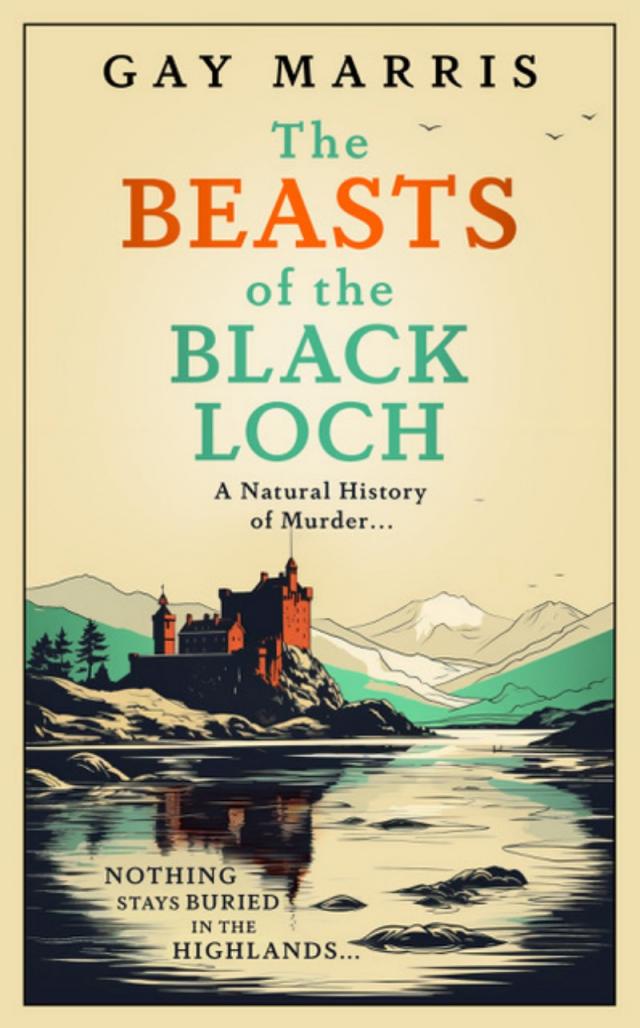
The beasts of the black.., p.1
The Beasts of the Black Loch, page 1


JOIN OUR COMMUNITY!
Sign up for all the latest news and get free books and exclusive offers.
BEDFORDSQUAREPUBLISHERS.CO.UK
For S, F, & J.
The best people I know.
Prologue
The High Road
The car was speeding, true, but the driver knew the twisting single-track road through the forest like the back of his hand. Seldom another a vehicle, just blisters in the tarmac, hair-pin bends, and the occasional rattle-tattle cattle grid to make him sit up straight. This January morning, though, there was a thick frost, he and his wife were bickering, and then, out of nowhere, there was a person… walking… not along the verge, but directly ahead of them. The walker didn’t get out of the way. The driver hit the brakes… and hit them again, to no effect, because they’d been cut. And so it was that the car skidded full pelt into the trees and exploded into flames. Whoosh! The blazing vehicle sent a column of thick black smoke, tall and straight into the pristine, windless, sun-up sky. Acrid fumes mingled with the resinous scent of scorched pine needles and the stench of cooking flesh. These sounds and smells frightened the forest animals and made the deer scream.
1
The Low Road
The trip from the West Indies to Scotland is taking an eternity. That’s what it feels like. Bloody forever. Dr Ava Wheatsheaf Dickens (BSc [Honours Zoology], PhD) hates aeroplanes, hates trains, and loathes sitting still. She left Trinidad yesterday afternoon, has barely slept since, and is utterly and completely travel sick. Not the puking up kind of sick, more’s the pity. That would resolve itself with a few heaves. Ava’s suffering from the insidious nausea she experiences every time she ends a lengthy spell in the jungle to re-enter ‘civilisation’. She knows she’ll acclimatise. Nevertheless, it’s a shock to the system.
The flight was horrendous. The 1970s it may be, and Ava’s generally fearless, but her gut feelings about modern air travel are basic. The thought of being catapulted into the sky to be kept aloft by the intangible forces of lift, thrust, and drag, always fills her with trepidation, which, she reminds herself, is why she’d requested a window seat. She hoped if she could see where she was going she’d feel less helpless. This was a mistake. No sooner was the gut-wrenching take-off complete than the lights of Port of Spain disappeared, swallowed up by the rapidly retreating landscape before she had time to watch them fade. And that had been that; all sight of earth or ocean concealed by a menacing carpet of cotton-wool clouds. Her only clues to progress, jaunty updates from the stewardesses. Underneath their inscrutable regulation-red lipstick and stiff little hats, surely they too were terrified?
Apparently not. ‘We are currently cruising at thirty-five thousand feet, one thousand miles from the coast of Africa and two thousand miles from the coast of America.’
Dangling smack bang over the bloody North Atlantic! Who needed to know that, for God’s sake? Not that Ava believes in God, any more than she believes in the Devil. The Origin of Species, that’s her bible. When it comes to the question of Creation, Charles Darwin answered it eloquently. Her own philosophy, derived from His, is simple: respect all life, keep an open mind, and leave flying to the birds.
‘The air temperature outside is minus sixty degrees, my name is Penelope, and I’ll be coming down the aisle with the cocktail trolley.’
All too soon, Ava had smoked her nervous way through her entire stash of rolling tobacco. Not till several long hours later, after three White Russians and a Harvey Wallbanger – ‘don’t bother with the cherry’ – a tiresome headwind – according to the captain, ‘just some mild turbulence’ – and all the complimentary cigarettes Penny was prepared to dish out, did the plummet to London begin. And thanks again to her window seat, Ava had a perfect view of the urban sprawl hurtling up to meet her; a concrete vanguard of new tower blocks waiting, like a monolithic bed of nails, to rip out the plane’s underbelly should the pilot misjudge its descent. Fixing her eyes on the antimacassar in front, hands locked onto her armrests, she’d forced her imaginings elsewhere.
The lush green ferns of the rainforest.
She’d felt the pop of the undercarriage as the landing gear lowered.
The iridescent feathers of a hummingbird.
How the fuselage had shaken as the wheels touched down!
The astonishing emerald wing cases of a jewel beetle.
Then the monstrous roar of the engines as the aircraft careered along the runway – memories of goat curry – until they finally juddered to a halt.
‘On behalf of myself and the rest of the cabin crew, welcome to England. We trust you’ve had a pleasant flight.’
Darwin or no Darwin, Ava had murmured a private little prayer of thanks.
A bus took her to Victoria Coach Station, by which time the capital was already getting hot, and to Ava, who’s no longer used to traffic fumes, the fuggy air tasted like burnt coal. She and her hefty rucksack made the sweaty trek to the underground where they fought their way onto a suffocating rush-hour tube. Gripping a ceiling strap, deafened by the squealing rails, she’d stood chest to chest with other passengers as everyone stoically jostled and jiggled and lurched around. Eying the younger commuters, she noted how summer fashions have changed since she was last ‘home’. Then it was all miniskirts and cheesecloth; now, it seemed, denim jeans with flapping flares and shoes with breezeblocks for soles are the rage. Her own outfit – a crumpled linen trouser suit with plenty of pockets, belted at the waist – might not be ‘hip’, but at least she wouldn’t fracture an ankle if she needed to break into a run. Relieved to reach Euston, she’d made a vital pitstop to restock with Embassy and Rizlas, and found a phone box. The call she made to Alastair, to give him her ETA, was succinct, with her feeding two-pence pieces into the slot as fast as she could talk – but still she only just boarded the morning train to Scotland in the nick of time… and she’s been chugging due north ever since.
Ava peers at her travel-worn reflection in the grubby window. With features distorted by the thickness of the pane, she resembles one of her maiden aunts. Or her father? She touches her top lip, half expecting to feel his whiskery beard. She has his long nose and his high forehead. Lucky she has Mother’s cheekbones, or she’d have been a lost cause. It’s been a while since Ava made use of a mirror. She sees that her thick curls have gone haywire… and she’s really quite grey around the temples. The first silvery strands appeared in her early forties, to be joined by bushels more in the ensuing decade. When did she last comb her hair? Before she got on the plane. She should probably drag a comb through it now, but she can’t be bothered. Who cares what state she’s in, anyway.
Suddenly, Ava realises she’s being scrutinised. The man opposite, brown-skinned and very dapper, is observing her over the open review section of his Sunday Telegraph. She noticed him board at Stirling, several hours ago, caught a whiff of his cologne as he reached up to place his briefcase and neatly folded overcoat on the string luggage rack. He lowers his paper as if about to speak, but Ava looks away. She’s in no mood for exchanging forced pleasantries with some passing stranger. Besides, as a means of communication, speech is overrated. Early humans expressed themselves with gestures; a lowered brow, a roll of the shoulders peppered with the occasional grunt, conveyed everything we needed to convey. But when a twist of evolutionary fate gave us a voice box that let us articulate sounds other creatures couldn’t, we began to talk, and haven’t shut up since. Of course, people never stopped giving off the nonverbal signals they relied on in the past, they’ve simply lost the habit of reading them. Which is, in Ava’s learned opinion, a waste.
She steals a look at the chap opposite. It’s obvious from the way he’s shifted to face her directly, he’s determined to catch her attention. His head-on positioning, ubiquitous throughout kingdom Animalia, means ‘please take notice’, though the way he keeps touching his nose betrays residual wariness, too. These involuntary little mannerisms are vestiges of self-checking gestures Ava’s seen before. ‘Olfactory investigation’. Not just in primates. Dogs, cats, and rats are forever sniffing themselves, especially in situations they’re unsure of, seeking reassurances that their bodies smell right. So, without knowing he’s doing it, this suave man’s primal self is turning to his pretty much useless olfactory senses, asking them if he’s ready to engage a weary looking woman in a banal chinwag about the weather.
Mind you, moments earlier she was checking her own appearance. Did he catch her doing it! Now he’s stroking his immaculate moustache; a primitive act of preening, also ubiquitous. For her benefit? Surely not! Ava closes her eyes, shutting down any further attempts at conversation from him, or anyone else, and allows thoughts of her godson, Alastair, to swim to the fore. The only person on the planet for whom she’d make this trip. Not that they’ve been in regular touch. She hasn’t seen him for a few years. How old is he now? Twenty-four? Twenty-five? But she was, at one time, fond of his father. ‘Dashing Duncan Muirhead’, as her mother used to call him. ‘Why he married that Sheila Ferguson girl is anyone’s guess!’
‘Love, Mum. They fell in love. Couldn’t help it.’
‘Codswallop!’
Typical of Mother to take Duncan’s whirlwind volte-face personally. Her daughter got cast aside in favour of the beautiful Sheila Ferguson. Ava smiles wryly. Even if Ava had felt bruised, she recovered quickly. She was well practiced at going it alone, and Duncan couldn’t have fo und a kinder, more loyal partner than Sheila – who was also a far better candidate for domestication than Ava could ever have been. Sheila was the impeccable hostess of many a hunt ball. And it was Sheila, not Duncan, who kept in touch via letters throughout all the years Ava’s been working overseas. Ava was honoured to become godmother to their only son. She grew to rank Sheila among her dearest friends, which greatly irritated Mother. Terrible to think both Sheila and Duncan are gone. Snuffed out, just like that. No wonder Alastair’s struggling to cope.
Although raised as heir to the Loch Dorcha estate, he never expected to inherit so abruptly or so soon. One moment, a young man with a Master’s in the History of Herbalism, no meaningful responsibilities, and a yearning to backpack across China; the next, laird of fifty thousand acres of remote Scottish mountains and moors, and the eponymous ‘dark loch’. Not to mention Dorcha Hall. Now there’s a crumbling ancestral pile, if ever there was one. Ava’s most recent visit was ages ago and even then the place was going to seed. Duncan was aware of the amount of work it needed, but without the funds to start. His solution: angst-numbing quantities of whisky, self-administered, morning, noon, and night; enough to douse all embers of his ‘dashingness’, leaving behind an angry shell of a man Ava’s mother would never have recognised. Sheila’s strategy was denial. She focused not upon The Hall’s rattling window frames, but the magnificent aspects beyond.
Poor Alastair. Clever and, at the same time, unworldly. Much more of his mother in him than his father. Whereas Duncan would stride through the heather, shotgun under one arm, fishing rod under the other, his son eschews all blood sports. When Ava saw Alastair graduate from The University of Edinburgh he was like a freshly moulted insect yet to harden its skin; full of youthful promise, yet easily squished. Is he still like that? The loss of his parents must’ve been devastating. ‘A freak accident’, that’s what the police called it. Likely a deer jumped out, or a tyre blew… or Duncan simply skidded and lost control. Just one of those things. At least Alastair has his wife, Fiona, by his side, to console him. Ava missed the wedding, and the funerals, so she’s curious to meet her. According to Sheila’s final letter, ‘The girl’s a godsend’, ‘like the daughter I never had’. It’s a blessing Sheila and Duncan saw their son married. But what now?
She knows the young couple hasn’t a bean. Alastair’s told her as much in the missives he’s dutifully posted now that Sheila can’t. Despite his circumstances, they’re surprisingly heart-warming, full of appreciation for his new wife and his plans to keep the Loch Dorcha estate in the Muirhead line. In the last three months, he’s thrown all they’ve got into turning Dorcha Hall into a hotel; a notion as impractical as it is romantic. ‘My idea, but with Fee at my side, I can do anything.’ When Ava first read of this venture, she assumed Fiona must have experience in that most modern of industries, ‘hospitality’, given Alastair has none. She also supposed Fiona to have completed a sandwich course in Business Studies or, at the very least, adding up. Turns out Ava was wrong on all counts. She’s since learned that Fiona has a Master’s in Earth Sciences, also from Edinburgh, and, Ava fears, an outlook as blindly optimistic as her new husband’s. The fact ‘The Hall’ is failing is unsurprising, and also very sad.
Daft buggers, Ava sighs to herself. Perhaps she should have tried to dissuade them from such folly? Then again, who’s she to crap on their dream? Hence her flying visit, to provide support, this being of the moral rather than financial variety. She’s no better off than they are. Still, a few weeks’ holiday as a paying guest will add something to their coffers. And she’ll make the most of the northern latitude’s long summer days, by getting in some good hikes.
2
Rest Ye Well
Twenty-four hours after Ava left her bunkroom at the Simla field centre, Ava’s train scrapes to a halt at its terminus. Inverness. In their brief phone conversation Alastair said he’d ‘send wheels’ to meet her, but neglected to detail what form these ‘wheels’ would take. However, when she spots a mud-green Land Rover parked among a rank of taxis, she makes an educated guess. Sure enough, as she approaches, a familiar character slowly climbs out and opens the front passenger door. It’s Angus Murdoch, Duncan’s old ghillie. A heavy, hairy person with a full beard, huge hands, and the most expressive eyebrows, he greets her with a surly nod. Ava doesn’t take this as unfriendly. Murdoch has always been a man of few words. She knows his character to be as solid as basalt, and his loyalty to the Muirheads, living or dead, is beyond reproach. That’s why Alastair keeps him on at the estate, to hack back hedges and chauffeur godmothers, despite the fact that he has little use for Murdoch’s skills.
Ava takes her seat and keeps quiet as Murdoch, with gear-crunching inefficiency, makes an eight-point turn to get out of the queue. While she’s literally looking the other way, she notices another vehicle exit the station car park. A Bentley. Claret red. Lots of chrome. The driver is the man from the train. He must live locally; left his car here when he made his outbound trip to Stirling. Passing the taxi rank, he slows down as though looking for someone, but it seems he doesn’t find them, for all at once he turns onto the main street and slides away.
‘Dr Dickens, back again,’ rumbles Murdoch when they eventually head out of town. ‘You’ll have had a lang ride.’
‘Correct on both counts,’ says Ava.
This will be the sum-total of their intercourse for the next sixty winding miles as they cross the Highlands from east to west, but Ava doesn’t care. She’s happy to sit in silence for a couple of hours and enjoy the scenery. In the blink of an eye Inverness is left behind and the towns they pass through become sequentially smaller, and fewer and farther between. Flat fields and undulating hills give way to less compromising vistas, as monumental outcrops, carved out by ancient glaciers, rise up all around. A’ Ghàidhealtachd, ‘home of the Gaels’, is as imposing as it’s wild. Above these crags and windswept plateaus, eagles may soar, and though it’s July, Ava fancies she spies hints of snow atop the tips of the tallest Munros. The heather’s in full bloom. Distant silver streams slice the imperial purple fells, and even inside the car, the air smells like honey. Eventually, Ava starts recognising landmarks; a croft here, a sheep fold there, and when they reach Knockinch, she knows the end of her journey is nigh. Until Alastair was dispatched to Gordonstoun, this is where he went to school, as did Duncan before him. Knockinch is big enough to warrant a bus stop with a shelter, a police substation with a blue lantern, and a pub that has a horse trough outside, but it’s too out in the sticks and set in its ways for a supermarket. The Post Office doubles as a general store. By this time, however, all shops have long since shut for the day.
Murdoch’s course now runs the length of a wide, green valley floor and, as the sun slips below the horizon, they finally reach the coast. Here, the moody, darkening mountains meet the ocean, palisading the vast tidal inlet that is Loch Dorcha. It’s a sight Ava remembers well. Nevertheless, she catches her breath at the immensity, and the drama, of what’s before her. To either side, terraces sweep upwards as if manifested by the sea itself, so high their jagged pinnacle crests threaten to sever the sky. Lower slopes are mantled by woodland and moors, but the upper fells are exposed, rocky and bare. Stretching before her broods the briny, untamed loch itself. Ten miles long, a mile across, and said to be five hundred feet deep, it looks endless. This evening, its lapping waters are calm.
At this juncture there are, unless one chooses to drive into the sea, only two ways to go. A right fork immediately leads to the tiny baile of Drumapple then onwards, upwards and round to the estate of Beinn Beithe. To the left, the road disappears into thick, forbidding, Caledonian forest. They turn left. Though they continue to follow the contour of the shoreline, the loch is obscured by trees. Occasional gaps afford split-second vistas, like flickering frames from a silent movie, of the shore, of the water, and the mountains looming ever large. They’re on Muirhead turf now. And as another full mile rolls by, it strikes Ava that every larch and every pine she’s seeing belongs to Alastair. And so does every hidden worm, woodlouse, beetle, ant or fly.






